What Is a Job Application Service? Types, Steps and Who It Fits
By Scout Editorial Team · Published November 5, 2026
We make ApplyScout. We have a conflict of interest, and we handled it by naming where others fit better.
A job application service finds openings that fit you, submits applications on your behalf for a fee, and records each one. You set the target and keep the decisions that matter. The service takes over the repetitive part: searching, filling in forms, attaching the right resume and keeping track.
It is not a recruiter and it is not a job offer. It cannot make an employer interview you, and any provider that says it can deserves suspicion. This guide explains what these services do, how they differ from three kinds of help that often get confused with them, how the process works step by step, and who should and should not use one.
Key takeaways
- It is execution, not advice. A job application service does the application work. It does not tell you what career to pursue.
- Four types of help get mixed together. Human application services, AI or automated assistants, reverse recruiters, and career coaches or resume writers all solve different problems.
- You keep the target and the facts. You choose the roles and approve what is true about you.
- A record is part of the product. You should see the job, its status and the resume used for every application.
- Nobody can promise interviews. Employers make those decisions, whatever you pay.
What does a job application service actually do?
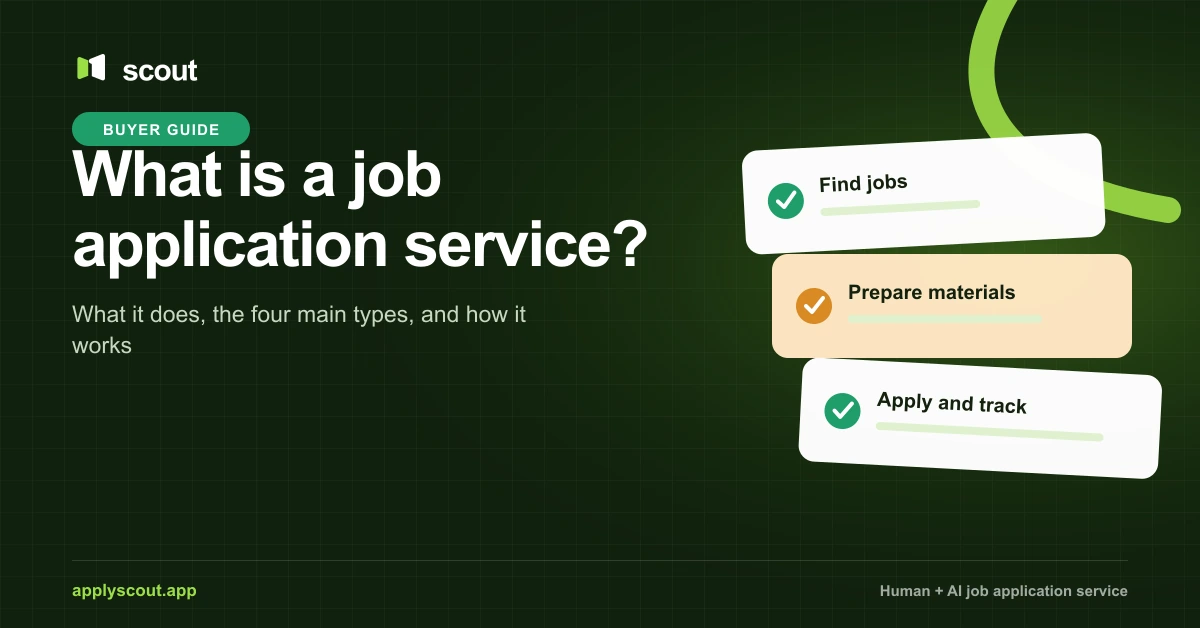
Applying for jobs is a chain of small, repetitive tasks. A job application service takes on most of that chain. The work usually falls into five parts.
- Finding roles. The service looks for openings that match the titles, locations, salary floor and dealbreakers you gave it.
- Filtering them. It drops roles that break your rules, such as the wrong seniority or a location you ruled out.
- Preparing materials. It chooses the right resume, or adjusts the wording of your real experience to suit the posting, and may prepare a cover note.
- Submitting. It completes the application form and repeated questions using facts you have approved.
- Recording. It logs each application so you can see the employer, the role, the status and what was sent.
A sixth job matters as much as those five: knowing when to stop. A good service pauses when a form asks something it cannot answer from your approved facts, instead of guessing.
What does it not do?
The limits are just as important, because this is where bad providers overpromise.
- It does not decide who gets hired. Employers do that. A service can get an application in front of an employer, and that is where its control ends.
- It does not do your interviews. Assessments, recruiter conversations and interviews are yours.
- It does not choose your career. If you do not know what role you want, a service has nothing sound to work from.
- It should not invent anything. Tailoring means rewording what is true, not adding skills, titles or results you do not have.
- It does not represent you to employers. It is doing application labor. It is not a recruiter pitching you to a hiring manager.
That last point is the most common confusion. An agency recruiter is paid by employers to fill their roles. A job application service is paid by you to handle your applications. For more on who pays whom, read do recruitment agencies take a percentage of your salary.
What are the four types of job application help?
Providers use overlapping labels, so a name on a website will not tell you much. Look at who does the work and what you actually receive.
| Type | Who does the work | What you get | Best when | Watch for |
|---|---|---|---|---|
| Human application service | A person, working from your rules | Applications submitted for you, plus a person to ask | The search needs judgment | Who the person is, and what proof you receive |
| AI or automated assistant | Software, within limits you set | Lower-cost applications at volume, with a log | The search can be written as clear rules | Wrong-fit roles and platform rules |
| Reverse recruiter | A person running a wider campaign | Positioning, outreach and coaching, often with applications | You want someone to run most of the search | Scope, and any percentage of salary |
| Career coach or resume writer | An advisor or writer | Advice, practice or better documents | Direction or your resume is the problem | You still apply yourself |
No label guarantees every item in its row. A coach may also write resumes. An application service may add some strategy. A reverse recruiter may lean heavily on applications and lightly on outreach. The written scope matters more than the category.
Human application service
Here a person does the applying. They work from your target roles and approved answers, and they can ask you a question when a form needs a decision. That judgment is what you are paying for, and it is why human services cost more than software. A person is a better fit for a career pivot, a senior role or applications with unusual questions.
The risk is opacity. “Our team applies for you” can mean many things, so ask who does the work and how you can check it. Our guide on using a virtual assistant for job applications covers the same questions if you are thinking of hiring someone directly.
AI or automated assistant
Here software finds, prepares and submits applications within rules you set. It costs less because no person is doing each application, and it suits a search you can describe in clear terms: titles, locations, seniority and exclusions.
There are two main risks. The first is fit, because software follows rules literally and can apply to roles you would have skipped if the rules are loose. The second is platform rules, because some sites do not allow automated activity on personal accounts. Before you use any automated tool, read whether auto-apply can get your job-board account restricted and how to stop auto-apply tools from applying to wrong jobs.
Note that an AI assistant is not the same as a browser tool that only fills in forms while you watch. Some products help you apply faster, while others apply for you. Check which one you are buying.
Reverse recruiter
A reverse recruiter works for the candidate and runs a wider campaign. That can include positioning, networking, outreach to hiring managers, coaching and negotiation support, and sometimes applications too. Because the scope is wider, this is usually the most expensive option, and some providers add a percentage of your first-year salary on top of a monthly fee.
If you want a person to run your whole search, this is a better fit than an application service, and we would rather tell you that than sell you the wrong thing. Scout does not do this work. Read what a reverse recruiter costs before you sign anything.
Career coach or resume writer
A coach helps you decide and improve. A resume writer produces a stronger document. Neither usually submits applications, so you still do that work. If you are unclear on direction, struggling to explain a career change, or losing out at the interview stage, this is the right kind of help, and an application service will not fix those problems.
It is a good pairing, too. Plenty of searches need a clear target and a strong resume first, and then someone to carry out the volume. For a full side-by-side, read reverse recruiters, coaches and application services compared.
How do you know which type you need?
Find your bottleneck. Ask these questions in order and stop at the first yes.
- Do you lack a clear target role? Start with a coach, or work through how to pick a target role.
- Is your resume untested or weak? Fix that first with a resume writer or a careful rewrite.
- Do you want someone to run the whole campaign, including outreach? Look at a reverse recruiter.
- Do you know the target but lack the time for the forms? A job application service fits. Choose a person if the search needs judgment and software if it can be written as rules.
If your search is a small number of carefully chosen roles, you may not need any of these. Doing the applications yourself can be the right call, and it costs nothing.
Human or AI: which kind of service should you pick?
If you have settled on a job application service, the next choice is who does the work. Choose software when your search can be written as stable rules: a defined group of titles, locations, seniority levels and exclusions. Choose a person when context changes the answer, such as a career pivot, a senior role or forms that often need a decision from you.
At Scout these are separate lanes, and one does not escalate into the other. If the AI is uncertain, the application can pause and return to you. It does not pass to a Human Assistant. So AI plans cost less, but more of the judging stays with you.
How does a job application service work? The Scout flow, step by step
Every provider runs this differently, so here is the one we can describe exactly: our own. Scout is a managed job-application service with two lanes. In the Human Assistant lane, a person applies for you. In the AI Assistant lane, a lower-cost agent applies for you. Both lanes use the same profiles, dashboard and browser extension.
No call is required to start. If you would like to talk first, you can Book a free call, but it is optional.
Step 1: Create your account and choose a lane
Sign in with Google or email, then choose Human or AI. The choice comes down to how much judgment your search needs, and our guide to human vs AI job application services can help you decide.
Step 2: Import your resume and review what Scout extracted
Scout analyzes your resume and shows you what it extracted: your experience, education, skills and the answers that application forms ask for repeatedly. Review this carefully, because it becomes the source for what goes into your applications. Your original resume stays as it is.
Step 3: Check your job profile
Scout prepares your first job profile, and you open your dashboard with it saved. The profile holds your target roles, locations, salary floor and dealbreakers, and Scout matches jobs against it. Check that it says what you actually want, because bad targeting means bad applications. If you are searching for different kinds of roles, you can create more than one job profile, up to your plan’s limit.
Step 4: Activate a plan from your dashboard
Your dashboard opens with your profile saved, and you activate a plan there to begin. AI Assistant plans start at $39 a month, and Human Assistant plans start at $299 a month. If you choose Human, Scout assigns your assistant and creates a dedicated WhatsApp group, so you have a direct line to the person doing the work.
Step 5: Applications start, and you track each one
Scout finds matching jobs for your profile. If you spot a role yourself, add it from your dashboard or with the Scout for Chrome extension, and choose which job profile and resume it should use. You decide whether Scout tailors a copy of your resume to each job or uses your original. You can allow automatic approval for routine matches, or require approval for every role. How Scout keeps applications safe explains these controls.
Your tracker shows each job, its status, the submission time and the resume used. Both lanes give you that record. Human plans also include screenshots of important form answers, while AI plans do not include form-answer screenshots.
From there, replies come to you. You handle the interviews and the decisions about what to do next.
What does a job application service cost?
Prices vary widely because the work varies. Software costs least, a dedicated person costs more, and a reverse recruiter usually costs the most. For market prices across provider types, see how much a job application service costs.
Here is what Scout charges, in US dollars.
| Plan | Lane | Monthly | Applications a month | Active job profiles | 90 days |
|---|---|---|---|---|---|
| AI Essential | AI | $39 | 75 | 1 | $105 |
| AI Plus | AI | $79 | 200 | Up to 3 | $213 |
| Focused Search | Human | $299 | 250 | 1 | $807 |
| Full Search | Human | $499 | 500 | Up to 2 | $1,347 |
| Career Campaign | Human, 2 Human Assistants | $999 | 1,000 | Up to 4 | $2,697 |
Prepaying 90 days saves about 10%. There is no placement fee and no percentage of your salary. There are only two AI plans. See the pricing page for current details.
Before you compare prices, compare what they cover. A low price for software you must supervise and a higher price for a person who asks you questions are different purchases. It also pays to check what happens to applications you do not use, and how cancellation works.
What should you keep for yourself?
Handing over the forms does not mean handing over the search. Keep these with you, whichever type of help you use.
- The target. You pick the roles, locations and salary floor.
- The facts. Your resume has to stay true. Check what a service extracted or tailored, and read can a job service change your resume so you know what to allow.
- Sensitive answers. Work authorization, sponsorship, salary expectations, relocation, disability and demographic disclosures, and criminal history should come from you. Give approved answers where the truth is stable, and require the service to ask rather than guess.
- The first review. Check the first batch before you allow more volume.
- The conversations. Employers will contact you, and what happens next is up to you.
What should you expect from a good service?
A short list covers most of it. A good service states its price and scope in writing, shows you a record of every application, tells you who or what does the work, works only from your real experience, lets you set and change your rules, and makes it clear how to cancel. It also says plainly that it cannot promise interviews.
For the full test, use the 10 checks in are job application services legit. For a list of what a record should contain, read what proof an assistant should provide.
A few warning signs are worth knowing now:
- A guaranteed job or interview.
- Only a total count, with no way to see individual applications.
- An offer to add experience you do not have.
- A request for your main email password or LinkedIn password over chat.
- Claims that automation is “undetectable.”
Who is a job application service for?
It tends to suit people with a clear target and too little time. That includes people working full time who cannot fit applications around their job, people who have been applying alone and are worn out by the repetition, and people running a search across more than one kind of role. Our guide to job searching while working full time covers that situation.
It is a weaker fit in these situations:
- You are not sure what role you want next.
- Your resume has not been tested, or you suspect it is the real problem.
- You apply to only a few roles, and each one needs careful, personal work.
- Your field runs mostly on referrals and relationships.
- The fee would strain your budget. With no promised outcome, the money has to be money you can afford to spend.
Software tools can also be a better choice than a managed service if you want the lowest price and are happy to supervise the work yourself. And if you want outreach to hiring managers, a reverse recruiter does more than Scout does. To see how providers compare, read our best job application services guide, keeping in mind that we wrote it.
Is a job application service a good idea?
It is a sensible purchase when the numbers work for you. The main thing you are buying is time, so compare the hours you would get back with what those hours are worth, and count only applications you would be happy to have sent. We work through the arithmetic with stated assumptions in is a job application service worth it.
More applications also do not fix everything. If your applications are well targeted and your resume works, extra volume can help you cover more ground. If they are not, volume spreads the same problem further. Read application volume vs interview rate for how to think about that balance.
The safest way to start with any provider is small: the shortest term available, a first batch you review closely, and more volume only once the work passes your rules.
Frequently asked questions
What is a job application service?
It is a paid service that finds openings that fit you, submits applications on your behalf and records each one. You set the target and keep the key decisions. It does not guarantee interviews or offers, because employers make those decisions.
How is a job application service different from a recruiter?
An agency recruiter is paid by employers to fill their roles. A job application service is paid by you to handle your applications. A reverse recruiter is also paid by you, but runs a wider campaign that can include outreach and coaching. Read the three services compared.
Is a job application service the same as auto-apply?
Not always. Auto-apply is software that submits for you, and it is one type of service. A human application service uses a person. Scout offers both as separate lanes, a Human Assistant and an AI Assistant, and both record the job, status and resume used.
Do I need a call to start with Scout?
No. Create an account, choose Human or AI, import your resume, then Activate a plan from your dashboard. A free call is optional if you would like to ask questions first. You can Book a free call.
How much does a job application service cost?
At Scout it costs $39 to $999 a month: $39 and $79 for AI plans, and $299, $499 and $999 for Human plans. There is no placement fee and no percentage of your salary. For market prices, see how much a job application service costs.
See how it works for you
Compare the Human Assistant plans and the AI Assistant plans, read how Scout works, or see every plan on the pricing page.