Job Application Service, No Interviews? What to Do
By Scout Editorial Team · Published October 1, 2026
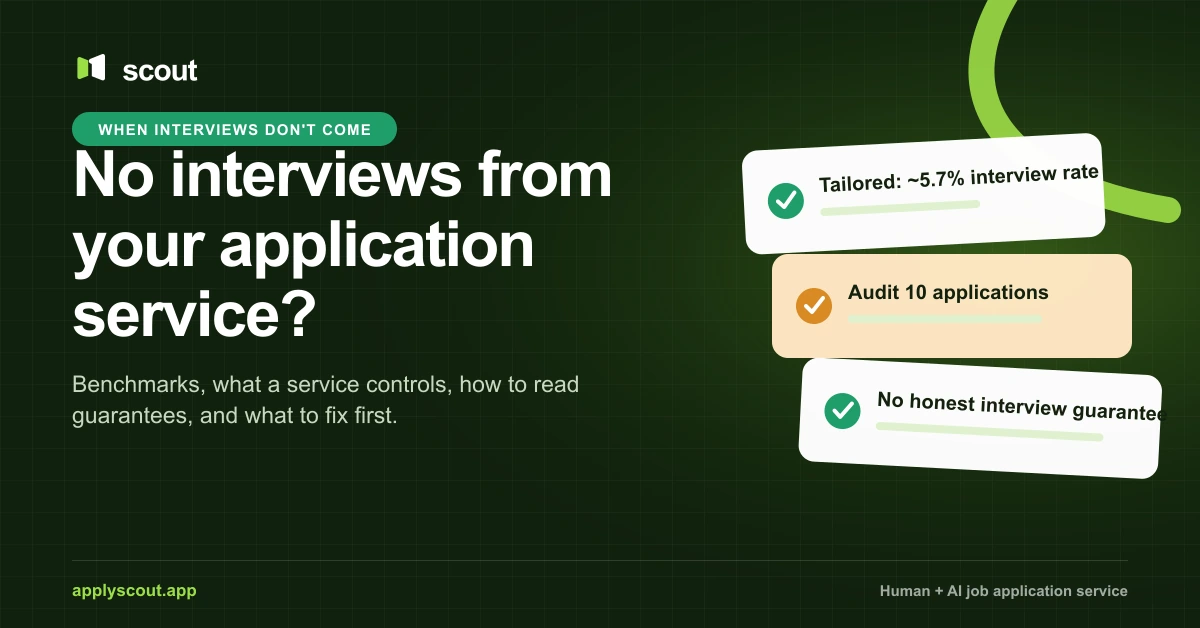
If a job application service isn’t producing interviews, the cause is usually targeting, materials or market, not volume alone. Published data puts a typical interview rate somewhere around 3 to 6 percent of applications, so check your numbers against that before deciding the service failed. A service can’t control who gets an interview, because employers decide that. What a good service can do is show you every application, help you find the bottleneck, and let you pause or change course without a fight.
Here is how to tell a slow start from a real problem, and what to do about each.
What a normal interview rate looks like
Before you judge any service, you need a baseline. The best public data we have found comes from job-tracking platforms that see millions of real applications.
Huntr, a job search tracker, analyzed 1.99 million applications from October 2024 to June 2026. Applications sent with a tailored resume reached an interview 5.71 percent of the time, versus 3.09 percent for untailored ones. That is roughly one interview per 18 tailored applications and one per 32 generic ones.
The same Q2 2026 report found where you apply matters too. Applications on employer career sites converted at 6.42 percent, versus 3.82 percent for job boards and aggregators.
And timing is slower than most people expect. Huntr’s median time to a first interview in Q2 2026 was 23 days, and the median time to a first offer was 82 days.
The employer side tells the same story. Ashby, an applicant tracking system, reported in May 2026 that applications per hire have tripled since 2021 to more than 300, and candidates are roughly 50 percent less likely to get an interview than five years ago, based on over 100 million applications.
So if a service has sent 40 well-targeted applications in your first two weeks and you have no interviews yet, that is disappointing but not proof of failure. If it has sent 200 over six weeks with zero responses, something is off.
Why results vary so much between people
Two people can buy the same plan and get very different outcomes. A few reasons:
The market for your role. In August 2026, U.S. employers had 7.1 million job openings and a hires rate of 3.3 percent, but those averages hide huge differences between fields. A nurse and a junior product manager are not in the same market.
Seniority and fit. A senior candidate with a narrow specialty might apply to fewer roles and convert more of them. A career changer often applies widely and converts less, because the resume does not yet tell a clean story.
Work arrangement. In Huntr’s Q2 2026 data, remote-only roles converted at 3.53 percent, compared with 6.07 percent for hybrid and 5.86 percent for onsite. If you only want remote work, expect a lower rate.
Referrals. Ashby’s 2026 benchmarks found 52 percent of referred candidates pass initial screens, compared with 35 percent overall. A cold application service cannot create referrals for you, and that is a real ceiling.
Volume itself. Huntr found that among people with 11 or more applications in Q2 2026, interview rates fell from 8.12 percent for those sending 11 to 20 applications to 2.86 percent for those sending more than 100. That does not prove high volume causes worse results. People who struggle tend to apply more. But it is a warning against treating application count as the goal. We go deeper on this in application volume vs interview rate.
What a service controls, and what it doesn’t
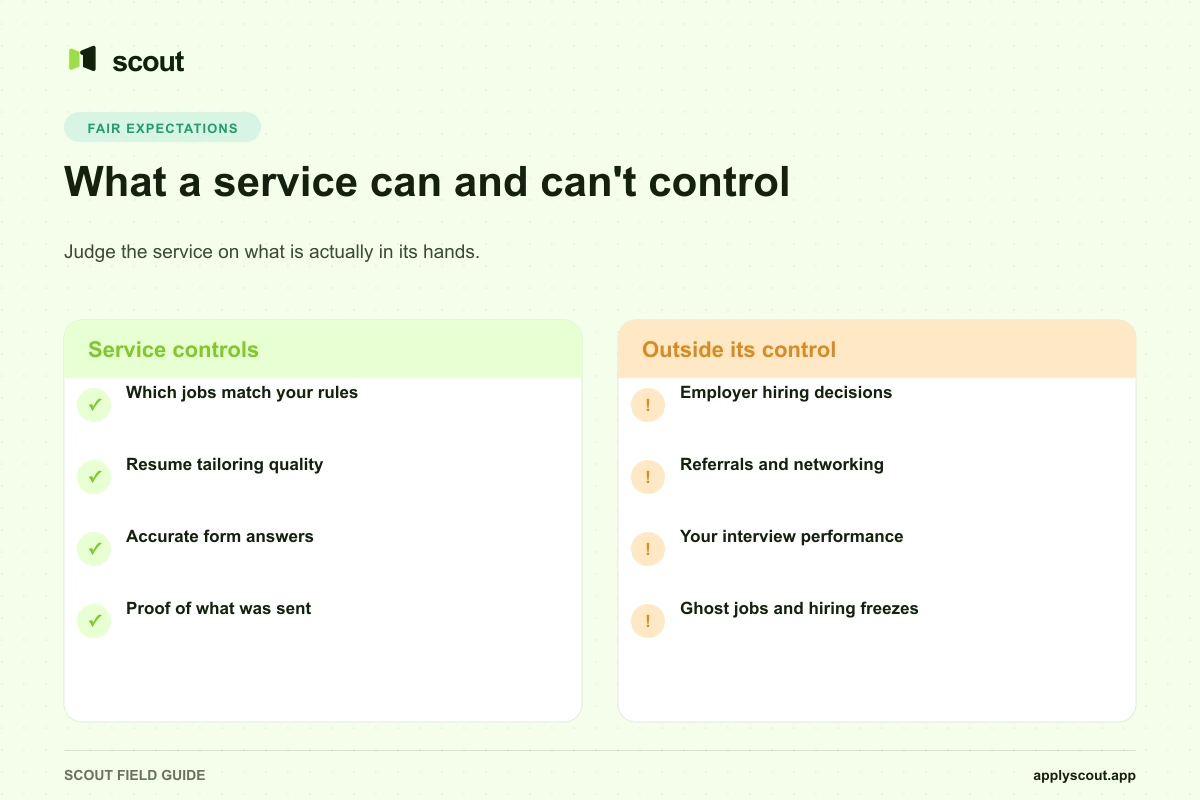
Be fair to the service and to yourself. Some things are on them. Some are on you. Some belong to nobody.
| Factor | Service controls | You control | Nobody controls |
|---|---|---|---|
| Which jobs get applied to | Yes, within your rules | You set the rules | |
| Whether roles match your target | Yes | You define the target | |
| Resume tailoring quality | Yes | You supply true, complete experience | |
| Accuracy of form answers | Yes | You confirm salary, visa and location answers | |
| Speed of applying to new postings | Yes | ||
| Proof of what was sent | Yes | ||
| Your work authorization and location | Partly | Employer policy | |
| Referrals and networking | Yes | ||
| Interview performance | Yes | ||
| Employer decisions, ghost jobs, hiring freezes | Yes |
If the problems sit in the first column, you have a legitimate complaint. If they sit in the last column, a different service will not fix them.
How to read guarantees and refund terms
Be skeptical of “guaranteed interviews.” The FTC warns that legitimate firms won’t ask you to pay for certifications, directories of jobs, or job guarantees, and its older guidance makes the point directly: legitimate firms that charge fees for resume and job listing services are selling information, not promising you a job.
The same 1996 FTC release flags “up-front fees coupled with refund guarantees” as a red flag. That does not mean every refund policy is suspicious. It means the refund promise should be specific and in writing.
U.S. advertising rules back this up. Under the FTC’s guarantee guides, a seller should use phrases like “Money Back Guarantee” only if it refunds the full purchase price at the purchaser’s request, and any ad mentioning a satisfaction guarantee should clearly disclose any material limitations or conditions. This is a summary, not legal advice, and rules differ outside the U.S.
When you read a service’s terms, translate the marketing words:
- “Interview guarantee” often means more applications, not money back. Ask which one.
- “Refund if no results” needs a definition of “results” and a deadline.
- “Unlimited applications” may hide daily caps or limited site coverage.
- “Cancel anytime” should say whether the current month is refunded or simply not renewed.
Read the actual terms page, not the sales page. For Scout, that is /terms.
The diagnostic checklist when interviews don’t come
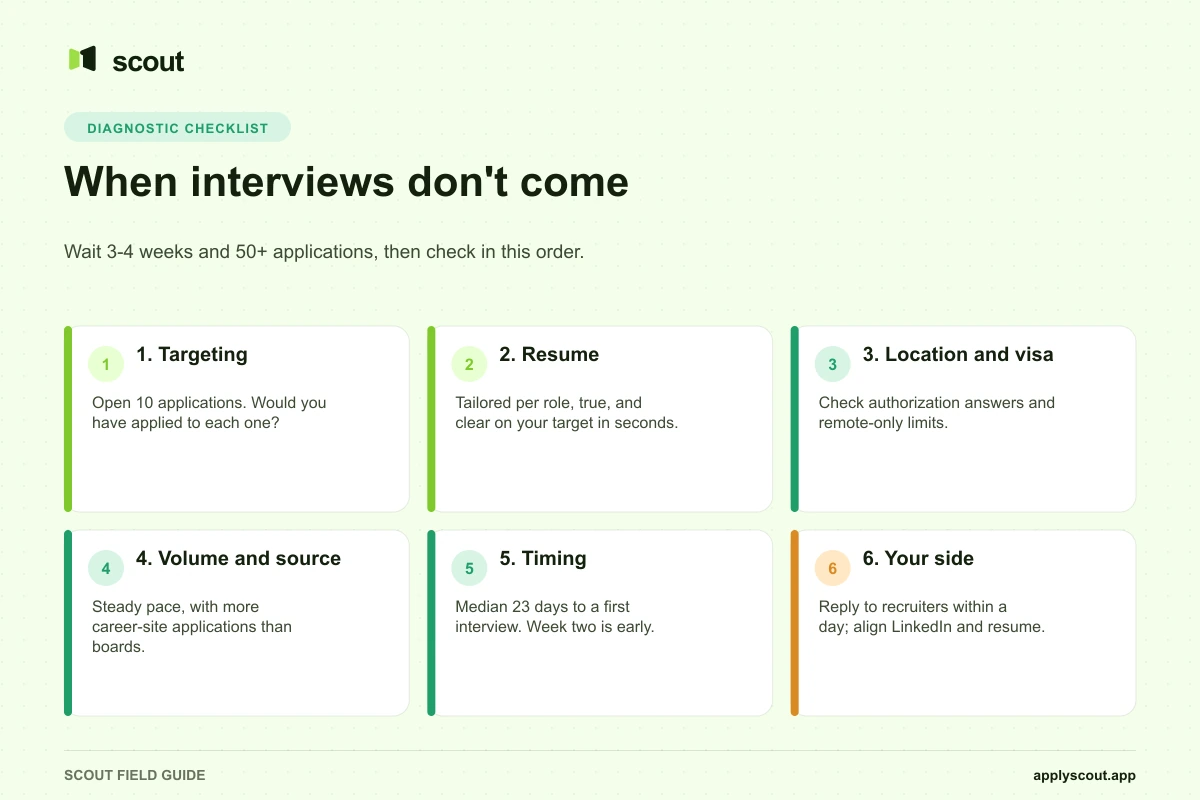
Give a service about three to four weeks and at least 50 applications before you judge the rate. Then work through this list, in order. Most problems show up in the first two items.
1. Targeting
- Open 10 random applications from the dashboard. Would you have applied to each one yourself?
- Do the titles match your real level, or are they a step too senior or too junior?
- Are industries or company sizes drifting from what you asked for?
2. Resume
- Does the top third of the resume make your target role obvious at a glance?
- Is it tailored per role, or the same file every time? The tailored versus untailored gap in Huntr’s data is large enough to matter.
- Is every claim true and something you can defend in an interview?
3. Location, visa and work arrangement
- Are form answers about work authorization and sponsorship correct?
- Are you applying to roles that are remote “within a country” you don’t live in?
- If you only want remote roles, have you accepted that the rate will likely be lower?
4. Volume and source
- Is the service applying on employer career sites, or mostly through job boards?
- Is volume steady, or did 150 applications go out in one burst and then stop?
5. Timing
- How old were the postings when applications went in? Fresh postings are usually worth more than stale ones.
- Has enough time passed? With a median of 23 days to a first interview, week two is early.
6. Your side
- Are you answering recruiter emails and calls within a day?
- Is your LinkedIn profile consistent with your resume?
Say you have 120 applications over four weeks and two interviews. That is about 1.7 percent. Compared with Huntr’s 3 to 6 percent range, the gap points to targeting or resume, not bad luck. Fix those first, then keep volume steady.
What to ask before you buy
Send these questions to any service and compare answers side by side:
- “Do you guarantee interviews? If so, what exactly do I get if I don’t receive them?”
- “Can I see every job you applied to, the resume used, and the answers you gave?”
- “How do you decide a role fits me, and can I set exclusions?”
- “Will you ever add skills or experience I don’t have?”
- “What happens to applications for jobs that turn out to be expired or a poor fit?”
- “How do I pause or cancel, and what is refunded?”
- “Who do I talk to when something looks wrong, and how fast do they reply?”
If the answer to question 2 is vague, stop there. Without proof you cannot run the checklist above. Our guide on what proof a job application assistant should provide lists the minimum evidence worth accepting.
How Scout handles this
Scout does not guarantee interviews. Employers decide that. If another service offers a guarantee, ask for the exact written terms before you compare.
What Scout’s Human Assistant does: a dedicated person finds roles that match your profile, tailors your resume using your real experience and never invents anything, and applies for you. You work together in a private WhatsApp group, so when the diagnostic above points to a fix, you tell them and the next batch changes. Your dashboard shows each job, the resume used, and screenshots of important form answers, which is exactly what you need to audit targeting.
Plans are monthly, from $299 for Focused Search with 250 applications a month, and you can cancel anytime. There is no placement fee and no percentage of salary. If a job you requested cannot be applied to because it has expired or is not a fit, it is not counted against your plan. The AI Assistant starts at $39 a month if you want a lighter option. See the pricing page for current plans, and the human vs AI comparison if you are choosing between them.
When to pause or change approach
Keep going if the applications are well matched, the evidence is clean, and you are inside the first month. Interviews lag applications by weeks.
Change the inputs if the audit shows wrong-level roles, a generic resume, or form answers that screen you out. Ask the service to fix those, then judge the next 50 applications, not the old ones.
Pause the service if you have run two rounds of fixes and the rate is still near zero. At that point the bottleneck is probably your positioning or your target market, and more applications will not change it. A career coach, a resume rewrite, or a networking push for referrals will do more. If you are weighing those options, see reverse recruiter vs career coach vs job application service.
Switch services if the problems are in the “service controls” column and they won’t fix them, or if they can’t show you what they sent.
FAQ
How many applications should it take to get an interview?
Published data suggests roughly one interview per 18 tailored applications and one per 32 untailored ones, based on Huntr’s analysis of 1.99 million applications. Your rate can be higher or lower depending on role, seniority, location and market.
Can a job application service guarantee interviews?
Not in any way they can control. Employers decide who to interview. A “guarantee” usually means extra applications or a conditional refund, so read the written terms and ask exactly what you receive if it isn’t met.
How long should I wait before deciding a service isn’t working?
Give it three to four weeks and at least 50 well-matched applications. Huntr’s Q2 2026 data shows a median of 23 days to a first interview, so judging after one week is too early.
Is the problem my resume or the service?
Audit 10 applications. If the roles are wrong, that is the service. If the roles are right but nobody responds, look at the resume, your location and visa answers, and whether you are only targeting remote roles.
Should I ask for a refund if I get no interviews?
Ask if the service missed what it promised in writing, such as the number of applications, role fit, or proof. If the terms say interviews are not guaranteed and the work was done as agreed, a refund is unlikely, and that is normal.
Will sending more applications fix it?
Rarely by itself. Huntr’s data shows people sending over 100 applications in a quarter had lower interview rates than those sending 11 to 20. Fix targeting and materials first, then keep volume steady.
If you want a second opinion on whether your search setup is the problem, book a call and walk through your numbers.