Do Recruitment Agencies Take a Cut of Your Salary?
By Scout Editorial Team · Published September 11, 2026
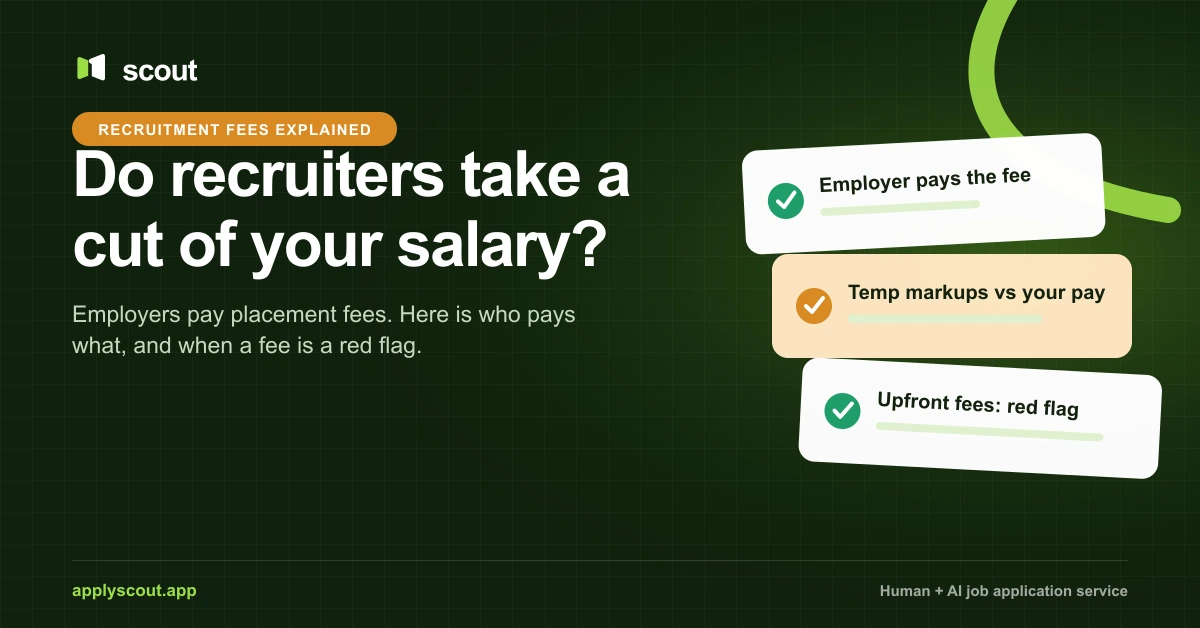
No. A legitimate recruitment agency does not take a percentage of your salary. The employer pays the recruiter a placement fee, usually a percentage of your first-year pay, and that money never comes out of your paycheck. The two exceptions worth knowing are temp or contract staffing, where the agency keeps part of what the client pays for your hours, and a few narrow, regulated cases where candidate fees are legal.
If someone asks you for money before you have a job, or wants a slice of your future salary, slow down. In many countries that request is illegal outright.
Who actually pays a recruiter
Most agency recruiters work for the hiring company. You are the product they place, not the client they bill. That sounds cold, but it is good news for your wallet.
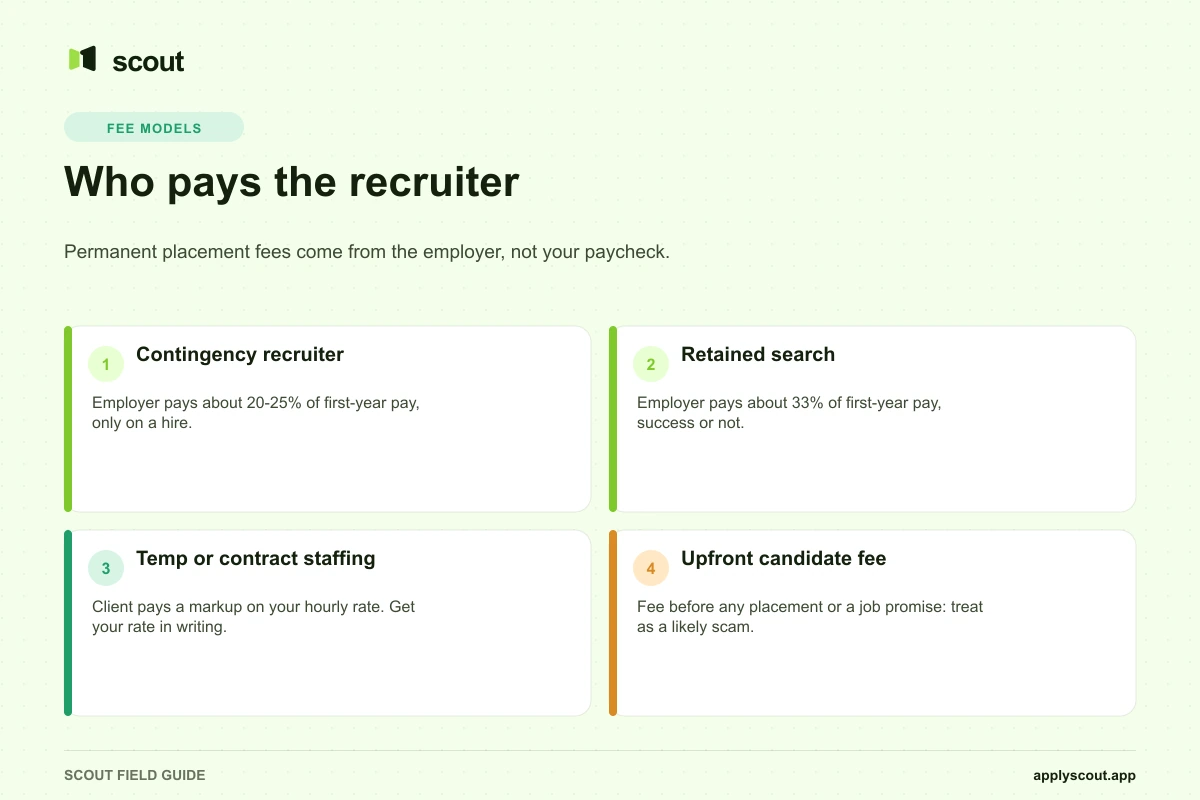
There are two common permanent-hire models:
Contingency. The agency is paid only if the employer hires someone it introduced. SHRM, citing executive search practitioners, puts contingency fees at about 20 to 25 percent of the role’s first-year cash compensation, meaning salary, bonus and signing bonus (2016 article).
Retained search. Common for senior roles. The same SHRM article says the industry’s standard fee is about 33 percent of the role’s annual salary, bonus and signing bonus, and the firm is paid whether or not the search succeeds.
Say you accept a job paying $80,000. At a 20 percent contingency rate, the employer pays the agency $16,000. Your offer letter still says $80,000. Your paycheck still reflects $80,000. The fee sits in the employer’s hiring budget.
The U.S. Federal Trade Commission puts it plainly: “Honest placement firms do not typically charge a fee to job candidates. Instead, the hiring company pays them a fee to find qualified candidates.”
Where charging candidates is banned or capped
Rules vary by country and sometimes by state. This is a plain-English summary, not legal advice. If money is at stake, check the current rules where you live or ask a local labour authority.
International baseline. Article 7 of the ILO Private Employment Agencies Convention (C181, 1997) says agencies “shall not charge directly or indirectly, in whole or in part, any fees or costs to workers.” Governments that ratify it can authorize limited exceptions for certain categories of workers and services, after consulting employer and worker organizations.
United Kingdom. Section 6 of the Employment Agencies Act 1973 says an agency “shall not request or directly or indirectly receive any fee from any person for providing services … for the purpose of finding him employment,” and breaking it is a criminal offence. The 2003 Conduct Regulations carve out narrow exceptions, mainly for performers, models and some publication listings, with cooling-off rights and refund conditions, set out in regulation 26 and Schedule 3. If you are an accountant, nurse or engineer in the UK, an agency asking you for a placement fee is a serious red flag.
India (overseas jobs). For recruitment to jobs abroad, India’s Ministry of External Affairs says a registered recruitment agent “cannot charge more than INR 30,000/- (exclusive of GST)” and that both the agent and the foreign employer must be registered on the eMigrate portal. That is a cap, not a ban, and it applies to emigration recruitment specifically.
New York State. New York takes a different route. Licensed agencies may charge some applicants, but only “after such agency has been responsible for referring such job applicant to an employer” and the person has been hired, under a written contract. For office, professional and executive jobs (Class B), the cap is a share of the first full month’s pay, rising to 60 percent where monthly pay is $1,650 or more. The same section generally bars agencies from taking an advance fee or deposit.
Notice the pattern. Even where candidate fees are legal, the law ties them to a real placement, caps them, and requires paperwork. A fee for “registration,” “processing” or “guaranteed interviews” before anything has happened fits none of those models.
Staffing and temp agencies: the markup, not your salary
This is where the “they take a cut” idea comes from, and it is half true.
When you work through a staffing firm on a temp or contract assignment, the agency is often your legal employer. The client pays the agency a bill rate for every hour you work. The agency pays your wage plus employer costs like payroll taxes, and keeps the difference.
For a sense of scale, Kelly Services, one of the large U.S. staffing companies, reported a full-year 2025 gross profit rate of 20.1 percent across its business. Gross profit is what remains after the direct cost of services, and it still has to cover the firm’s recruiters, offices and overhead.
Say a client is billed $30 an hour for your work. At a 20 percent gross profit rate, about $6 stays with the agency and about $24 goes to your wages and the employer costs attached to them. You never see a deduction labelled “agency fee.” The agreed pay rate is your pay rate.
What to check on a temp role:
- Your hourly pay rate, in writing, before the first shift.
- Who your legal employer is, and who pays you.
- Whether there is a fee if the client hires you permanently. That fee should be charged to the client, not to you.
- Whether any deductions appear on your payslip beyond taxes and items you agreed to.
Placement consultancies that charge candidates
In India and several other markets, you will meet “placement consultancies” that ask for a registration fee, a “file charge,” or a percentage of your first month’s salary after joining. Some are small, real businesses working in a grey area. Others are scams with a nice office.
For overseas jobs from India, the rules are clear enough to check: confirm the agent is registered on eMigrate and get a receipt, since the MEA’s guidance sets the service-charge ceiling. For domestic roles, we could not find a single national fee cap that applies to every consultancy, so treat any candidate fee with caution and get everything in writing.
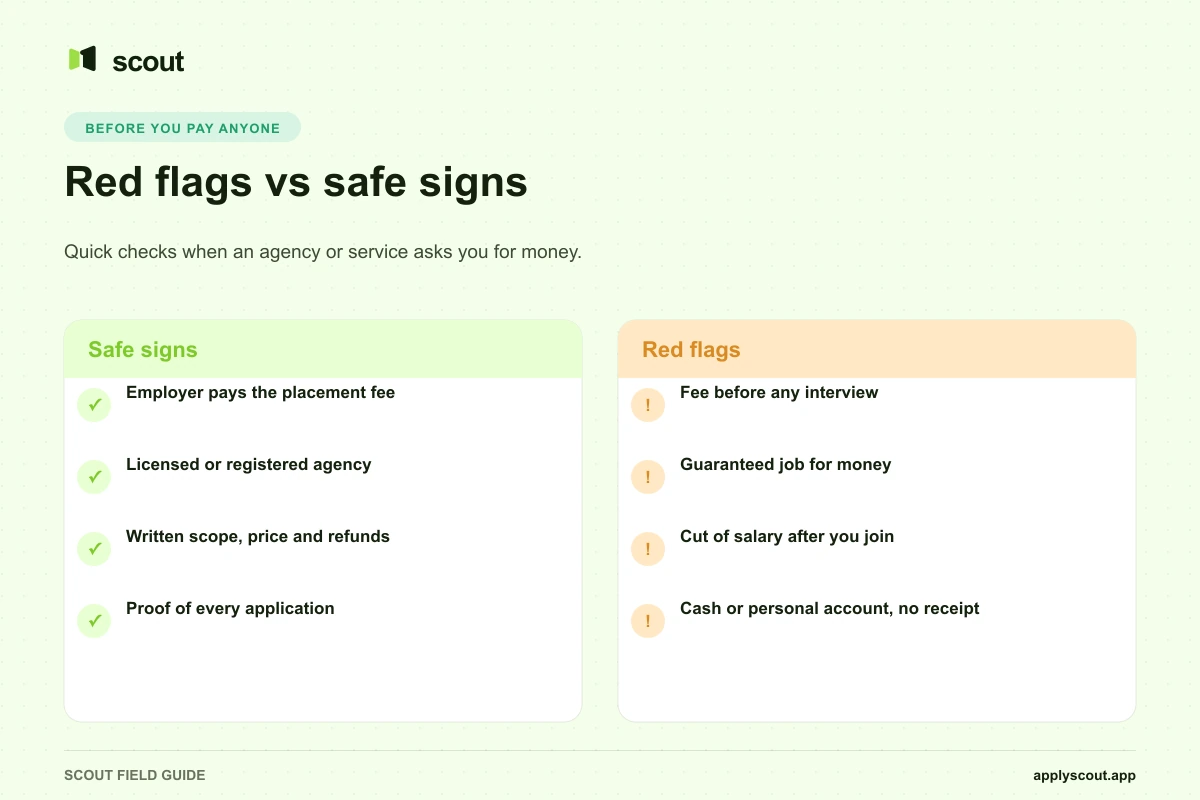
Red flags I would walk away from:
- Payment before any interview with a named employer.
- A promised or “guaranteed” job in exchange for money.
- A fee collected in cash or to a personal UPI ID or bank account, with no receipt.
- Pressure to pay today because “seats are filling.”
- A request for a share of salary for months after you join.
- No written contract naming the services, the fee and the refund terms.
- The consultancy will not name the employer until after you pay.
The FTC describes a version of this in the U.S., where executive placement scams took $1,200 to $2,500 upfront for resume and recruiting services and then set up staged interviews rather than real ones (2019). The FTC’s advice: “Many legitimate job placement firms get their money from the hiring company, not the applicant.”
Fee comparison: who pays what
| Model | Who pays | Typical basis | Paid from your salary? | What to verify |
|---|---|---|---|---|
| Contingency recruiter | Employer | Roughly 20 to 25% of first-year cash comp (SHRM) | No | They have a real mandate from the employer |
| Retained executive search | Employer | About 33% of first-year comp (SHRM) | No | Who the client is, confidentiality terms |
| Temp or contract staffing | Client company | Markup on your hourly pay | No, but the client pays more than you receive | Your pay rate in writing, legal employer |
| Licensed NY agency (some roles) | Candidate, after hire | Capped share of first month’s pay (NY GBL 185) | Yes, once, capped | License, written contract, fee only after placement |
| Overseas recruitment agent, India | Candidate | Max INR 30,000 + GST (MEA) | No, a one-time service charge | eMigrate registration, receipt |
| Flat-fee job application service | Candidate | Fixed subscription or package | No | Scope, volume, proof, cancellation |
| Upfront “guaranteed job” fee | Candidate | Whatever they can get | Often | Treat as a likely scam |
How a flat-fee job application service is different
A job application service is not a recruiter. It does not have a contract with the employer and cannot place you anywhere. You pay for labor: finding roles, tailoring your materials and submitting applications on your behalf.
That difference matters for how you judge it. The FTC drew this line back in 1996: “Some legitimate firms charge advance fees for executive counseling, resume writing and job listing services. But they’re selling information, not promising you a job.”
So the honest version of a paid service tells you exactly what work you are buying, shows you the work, and never claims to control the hiring decision. A dishonest one sells access, promises a job, or quietly ties its fee to your future salary. If you are comparing models, the reverse recruiter vs career coach vs job application service breakdown covers what each actually does, and how much a job application service costs shows how to compare prices on equal terms.
Where Scout fits
Scout is a flat-fee application service, not an agency. With the Scout Human Assistant, a dedicated person finds roles that match your profile, tailors your resume using your real experience (nothing invented), and applies for you. You talk to them in a private WhatsApp group, and your dashboard shows each job, the resume used, and screenshots of important form answers.
Plans are monthly, starting at $299 for Focused Search with 250 applications a month, and you can cancel anytime. There is no placement fee and no percentage of salary. The plan price is the only fee. If a job you asked for cannot be applied to because it expired or is not a fit, it does not count against your plan. Scout does not guarantee interviews, because employers make that call. If you would rather do more yourself, the AI Assistant starts at $39 a month. Full details are on the pricing page and in the terms.
Questions to ask any agency or service before you pay
Copy these into an email and ask for written answers:
- “Who pays your fee, and how is it calculated?”
- “Will any amount ever be deducted from my salary or invoiced to me after I start?”
- “Are you licensed or registered as an employment agency where you operate? What is the number?”
- “Which employer is this role with, and do you have a signed agreement with them?”
- “If I pay you, what exactly do I get, and how will I see proof the work was done?”
- “What is your refund and cancellation policy, in writing?”
- “Do you guarantee a job or an interview? If yes, what happens when it doesn’t happen?”
A legitimate recruiter will answer the first four in a sentence each. A legitimate paid service will answer the last three without hedging. For what good evidence looks like, see what proof a job application assistant should provide.
FAQ
Do recruiters take money out of my paycheck?
No. A permanent-placement recruiter is paid by the employer, usually as a one-time fee based on your first-year pay. Your salary is not reduced to cover it. If an agency asks you to sign over part of your salary, get advice before signing.
Does using a recruiter lower the salary I’m offered?
Not directly. The fee is a separate hiring cost to the employer. A recruiter on contingency is generally paid more when your salary is higher, so their incentive usually points toward a reasonable offer, not a lower one.
Is it legal for an agency to charge me a registration fee?
It depends on where you are. The UK bans fees for finding work outside narrow exceptions, ILO Convention 181 sets a no-fee baseline, and some places such as New York allow capped fees only after a placement. A registration fee before any placement is a warning sign almost everywhere.
Why do temp workers earn less than the client pays?
The staffing firm is usually the employer. It bills the client a higher rate, pays your wage and employer costs, and keeps the rest to run its business. Ask for your hourly pay rate in writing.
Is paying for a job application service the same as paying a recruiter?
No. A recruiter is paid by employers to fill roles. A job application service is paid by you to do application work. It should charge a disclosed, fixed price, show you proof of the work, and never promise you a job.
What should I do if I already paid a fake agency?
Contact your bank or payment service right away and ask for a reversal. In the U.S., the FTC says to report it at ReportFraud.ftc.gov or to your state attorney general. Elsewhere, report to local police and your labour or consumer authority.
If you want help with the application work itself, with one flat price and no cut of your salary, you can book a call or compare plans on the pricing page.