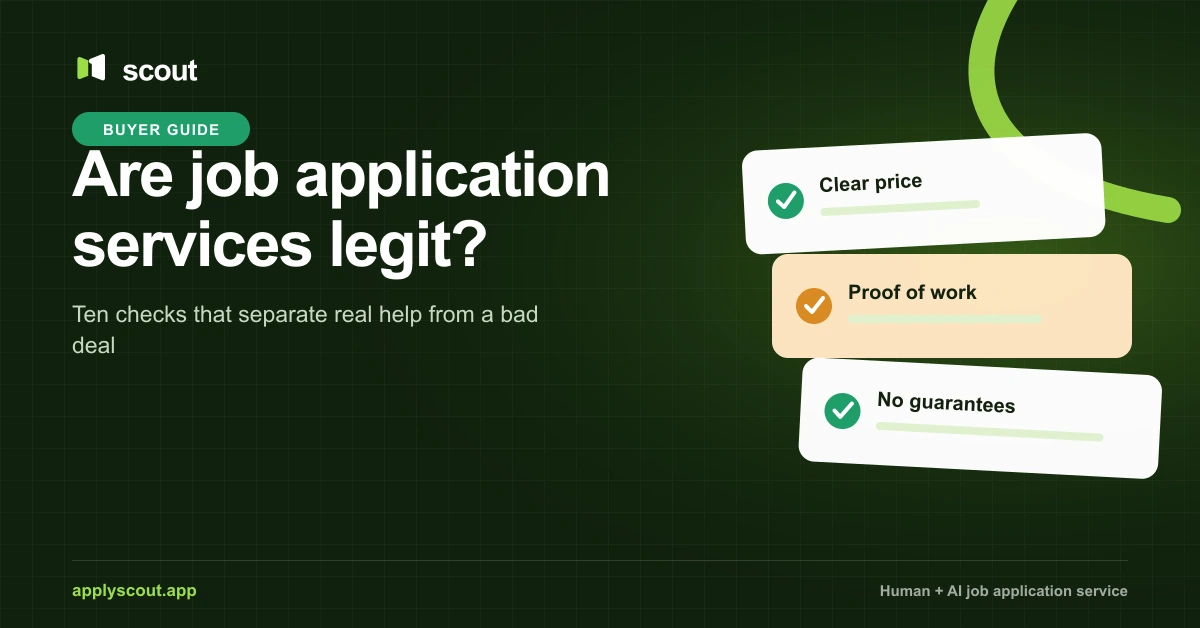
Are Job Application Services Legit? 10 Checks Before You Pay
By Scout Editorial Team · Published November 5, 2026
We make ApplyScout. We have a conflict of interest, and we handled it by grading ourselves on the same checks.
Yes, job application services can be legit: real ones sell visible work at stated prices and never guarantee a job. The harder question is whether the specific service in front of you is one of them. The label covers software, freelancers, small agencies and the occasional outright scam, so the name of the category tells you very little.
This guide gives you 10 checks, explains why paying as a job seeker deserves extra care, and applies the same checks to Scout, including where we fall short.
Key takeaways
- A guarantee is the clearest warning. Employers decide who they interview and hire, so no service controls that outcome.
- Pay for work you can inspect, never for the promise of a job. That one distinction removes most of the risk.
- Proof matters more than a count. You should be able to see the job, its status and the resume used for every application.
- Legit does not mean worth it. A real service can still be the wrong purchase for you.
What does “legit” mean for a job application service?
Three things have to be true.
- It does the work it says it does. Real applications go to real openings, inside the rules you set.
- You can see that work. You do not have to take a dashboard number on faith.
- It does not put you at risk. Your accounts, your personal data and your honesty all come out of the arrangement intact.
Results are not on that list. A legit service can send well-matched applications for a month and you can still hear nothing back, because employers decide. That is a different problem from fraud, and we cover it in what to do when a service produces no interviews. Whether a service is worth your money is a separate question too: see is a job application service worth it.
Why does paying as a job seeker need extra care?
Because the usual advice points the other way, and you should know that before you buy from anyone.
The Federal Trade Commission’s job scams page says, “Honest placement firms do not typically charge a fee to job candidates.” It explains that the hiring company pays those firms, and it tells you to walk away from a placement firm that asks you for a fee, especially one you must pay in advance. The same page says, “Honest employers, including the federal government, will never ask you to pay to get a job.” (FTC: Job Scams, read November 5, 2026.)
So here is the plain position. Job application services, Scout included, charge the job seeker. We think that can be honest for one reason: an application service sells labor, not placement. It has no opening to give you. You are paying for a defined task, in the same way you might pay a resume writer.
That argument only holds if the service behaves accordingly. The moment a business takes your money and implies it can deliver a job, an interview or special access to an employer, it is acting like the firm the FTC is warning you about, whatever it calls itself. Two rules follow:
- Never pay anyone for a job itself, or for access, equipment, training or a background check that a supposed employer requires.
- Only pay for work that leaves a record you can check.
The 10-check table
Run these before you pay. One failed check is a reason to ask more questions. Two or more is a reason to walk away.
| Check | What a legit service does | Red flag |
|---|---|---|
| 1. Outcome claims | Says plainly that it cannot promise interviews or offers | Guarantees a job, or a set number of interviews |
| 2. Price | States the price and what it covers before you pay | Gives a price only after a sales pitch, or adds fees later |
| 3. Fee structure | Puts any placement fee or salary share in writing | Springs a percentage of your salary on you, or charges to “unlock” a job |
| 4. Who does the work | Says whether a person, software or a mix submits | Answers with “our team” or “our technology” and nothing more |
| 5. Proof of work | Shows the job, status and resume used for each application | Shows only a total, or a summary you cannot trace |
| 6. Honest materials | Rewords your real experience and lets you check it | Offers to add skills, titles or results you do not have |
| 7. Your control | Lets you set targets and dealbreakers, and pause | Picks roles for you and cannot exclude a company |
| 8. Platform rules | Names the sites it uses and how it submits on each | Sells “undetectable” automation or says slow clicks make it safe |
| 9. Account and data access | Explains what access it needs and how to delete your data | Asks for your main password in chat, or bank details it has no need for |
| 10. Exit terms | Gives renewal, cancellation, refund and unused-volume terms in writing | Has no terms, or answers every question with “just contact us” |
How do you run the checks?
Promises and money (checks 1 to 3)
Read the sales page and the terms side by side, and check what any promise actually requires of you. Then find the whole cost. A monthly fee plus a percentage of your first-year salary is a very different purchase from a monthly fee alone, and some providers charge that way. For market prices, see how much a job application service costs.
The work itself (checks 4 to 7)
Ask who presses submit. A person and software both have legitimate uses, but the price and the failure modes differ, as our guide to human vs AI job application services explains.
Then ask to see a sample record before you pay. Each application should show the employer, role, date, status and resume version used. Our checklist of what proof an assistant should provide goes further.
Tailoring means choosing and rewording what is true about you. Your name is on that resume, so a service that adds a skill you lack is setting you up to fail. Read how to tailor a resume without lying so you know where the line sits.
Accounts and data (checks 8 and 9)
Some platforms restrict accounts for automated activity. LinkedIn’s help page says it does not allow third-party software or browser extensions that automate activity on its site, and calls that a violation of its User Agreement (LinkedIn Help: Automated activity on LinkedIn, read November 5, 2026). Other sites have their own rules, and pacing does not turn a prohibited method into an allowed one.
So ask where each application is actually submitted: inside your personal job-board account, or on the employer’s own application form. Those are different routes with different rules. Our guide on whether auto-apply can get your job-board account restricted lists the questions to put in writing.
A service needs your work history and the answers application forms ask for. It does not need your main email password sent over chat. Look for a privacy policy and a way to delete your account.
Leaving (check 10)
Ask three things in writing: how do I cancel, what happens to money I have already paid, and what happens to applications I have not used.
What about fake jobs?
A legit service can still apply to a bad posting if it never checks. Ask how a service screens postings and what it does when one looks wrong, and learn the warning signs yourself in how to spot fake and ghost job postings.
Be careful, too, with anyone who contacts you first. An unexpected message offering to find you a job, followed by a request for money, is not a service you chose. Start from a company’s own website, and pay through a normal checkout that gives you a receipt.
A quick way to verify any service
- Search the name. The FTC suggests looking up the company plus the words “scam,” “review” or “complaint.” It also notes that finding no complaints does not prove a company is honest.
- Send five questions by email. Who submits? What record do I get? Which sites do you use, and how? What do you need access to? How do I cancel? Keep the reply.
- Start small. Choose the shortest term available and check the first batch against your rules. Wrong-fit roles, an invented skill or a missing record are all reasons to stop.
How does Scout measure up?
Here are the same 10 checks applied to us. Verify them yourself.
- Outcome claims. We do not guarantee interviews or offers.
- Price. Plans are on the pricing page: AI Assistant plans are $39 and $79 a month, and Human Assistant plans are $299, $499 and $999 a month.
- Fee structure. There is no placement fee and no percentage of your salary.
- Who does the work. You choose a lane. A person does the work on Human plans, and automated fulfillment does it on AI plans.
- Proof. Both lanes show the job, status and resume used. Human plans add screenshots of important form answers. AI plans do not include form-answer screenshots, so that record is thinner, and you should weigh that against the lower price.
- Honest materials. Tailoring works from your real experience, and you can choose a tailored copy or your original resume.
- Control. You set target roles, locations, salary floor and dealbreakers in a job profile, and you can allow automatic approval for routine matches or require approval for every role. See how Scout keeps applications safe.
- Platform rules. Hold us to the same question. Before you start, ask how an application on any site you care about will be submitted, then confirm that route fits that site’s current rules.
- Account and data. Our privacy policy is public, and you can delete your account and its data yourself.
- Exit terms. Our terms say plans renew automatically until cancelled and that you can cancel from Settings. If refunds or unused applications matter to your decision, email support@applyscout.app and get the answer in writing before you pay.
One more point. Human plans use a dedicated WhatsApp group, and a stranger moving you to WhatsApp is a real red flag. The difference is the order of events: you sign up on our site first, and the group comes afterward.
When should you not buy any service?
Being legit does not make a service right for you. Skip it, at least for now, when:
- You cannot name your target role. A service executes a search, and it cannot choose your direction. Start with how to pick a target role.
- Your resume is the real problem. More applications will only spread a weak document further.
- The fee would strain your budget. With no promised outcome, do not pay with money you need for rent or food.
- You want introductions and outreach. That is a wider service. See reverse recruiters, coaches and application services compared.
New to these services? Start with what a job application service is. Ready to compare providers? Read our best job application services guide, keeping in mind that we wrote it.
Frequently asked questions
Are job application services a scam?
Not as a category, but scams exist under the same label. A real service sells application work at a stated price and shows you a record of each job. Be wary of anyone who guarantees a job, charges to unlock one, or cannot show what was sent.
Is it OK to have someone else apply for jobs for you?
Delegating the repetitive work is reasonable, as long as every fact submitted is true and you stay responsible for it. Keep decisions on work authorization, salary and personal disclosures for yourself, and check that the method fits each site's rules.
Should I ever pay a fee to get a job?
No. Never pay for a job itself, or for access to one. Paying for application labor you can inspect is a different purchase, and it should come with a written price, a record of the work and clear cancellation terms.
Can a job application service get my account restricted?
It can, if it performs activity a platform prohibits. Ask where each application is submitted and whether any automation runs inside your personal account. Read can auto-apply get your job-board account restricted.
How can I tell if a service really applied for me?
Ask for a record of each application: the employer, role, date, status and resume used. Then spot-check a few by looking up the posting. Some providers also show screenshots of form answers. Read what proof an assistant should provide.
Want to check us first?
Compare every plan on the pricing page and read how Scout keeps applications safe. No call is required to start, but if you would rather ask your questions in person, you can Book a free call.