How to Spot Fake and Ghost Job Postings Before You Apply
By Scout Editorial Team · Published September 8, 2026
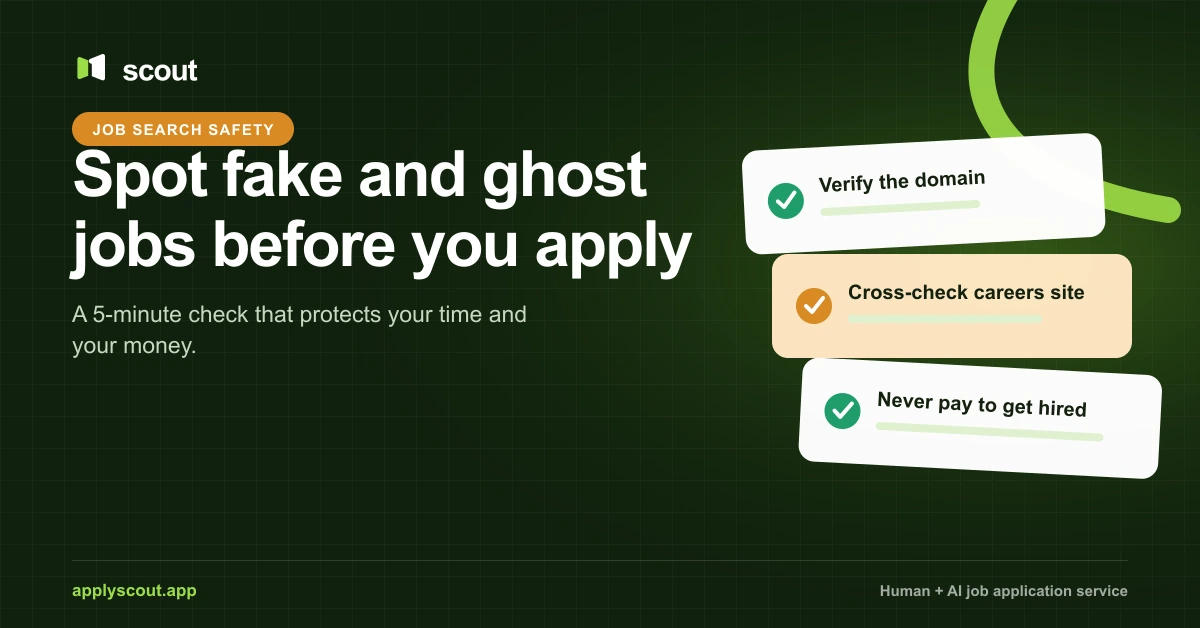
To spot fake job postings, check three things before you apply: that the job appears on the company’s own careers site, that every contact uses the company’s real domain, and that nobody is asking you for money, banking details, or a move to WhatsApp or Telegram. Ghost jobs are harder to catch, so also check how long the posting has been up and how often it has been reposted. Five minutes of checking saves hours of applications and, in the worst case, your savings.
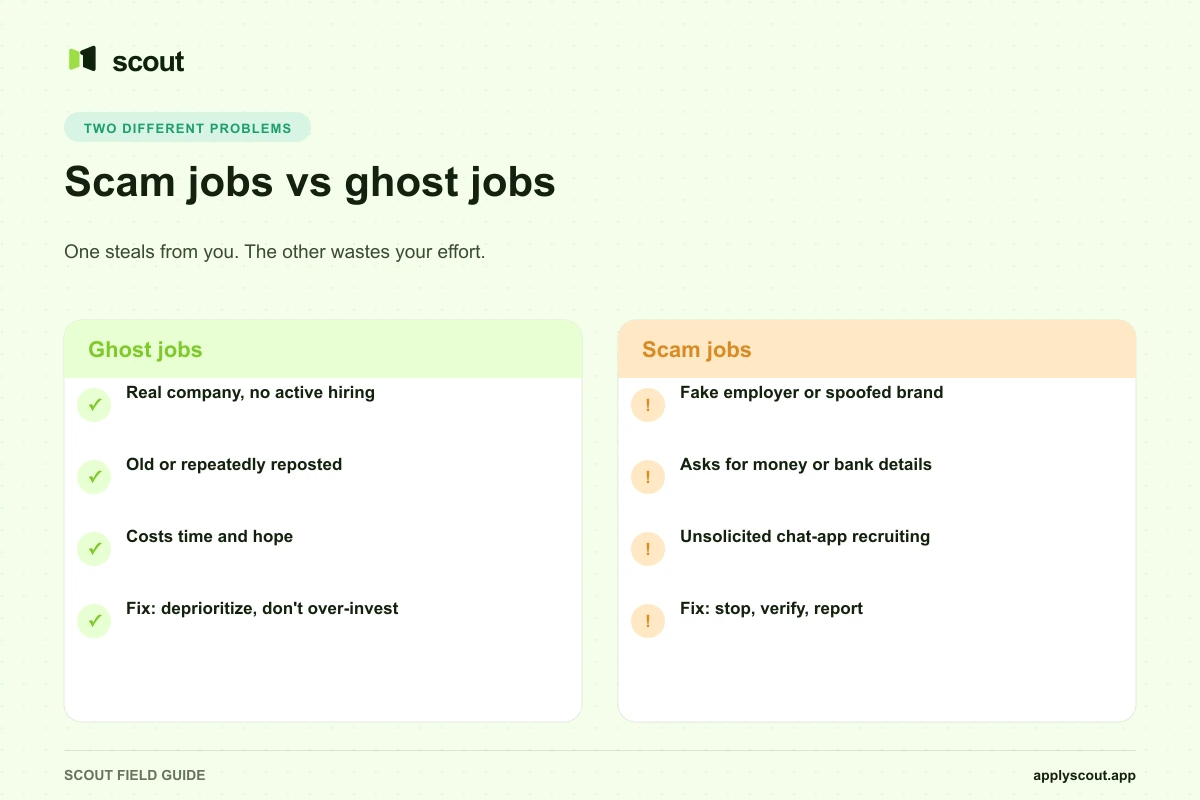
There are two different problems hiding under “fake jobs,” and they need different defenses.
- Scam jobs are fraud. Someone wants your money, your identity, or both.
- Ghost jobs are real companies advertising roles they aren’t actively filling. Nobody steals from you, but you lose time and hope.
How big the job scam problem is
Big, and growing. The FTC reported that job and employment agency scam reports tripled from 2020 to 2024, and reported losses jumped from $90 million to $501 million. That 2024 figure is the latest job-specific annual number the FTC has published as of this writing. For context on the wider trend, the FTC told Congress in March 2026 that consumers filed 3 million fraud reports with $15.9 billion in losses in 2025, up from just over $12 billion the year before.
The FBI sees the same thing from a different angle. Its 2025 Internet Crime Report logged 24,688 employment scam complaints with $362.9 million in losses, up from 20,044 complaints and $264.2 million in 2024. The same report notes victims lost almost $13 million to employment scams involving AI, including suspected voice deepfakes during online interviews.
The fastest-growing pattern is the “task scam.” In a December 2024 Data Spotlight, the FTC said about 20,000 people reported task scams in the first half of 2024, compared with about 5,000 in all of 2023, and that job scam losses topped $220 million in those six months alone. These start with an unexpected text or WhatsApp message, pay you a little for “app optimization” or “product boosting,” then ask you to deposit your own money to reach the next level. The money doesn’t come back.
How common ghost jobs are
Ghost jobs are harder to measure because the employer is the only one who knows the truth. Two data points are worth knowing, with caveats.
Greenhouse, an applicant tracking system, said in its 2024 State of Job Hunting report that 18 to 22% of jobs posted on its platform in a given quarter are classified as ghost jobs, and three in five candidates surveyed suspect they’ve run into one. That’s the closest thing to platform data we have.
ResumeBuilder’s May 2024 survey of hiring managers is the source of the widely quoted “40% of companies posted a fake job this year” and “3 in 10 currently have one.” The top reasons respondents gave were to appear open to external talent (67%) and to create an illusion of growth (66%). Read the methodology before you repeat those numbers: it was a Pollfish panel with screening criteria, and 649 of 1,641 initial respondents completed it. Useful signal, not a census.
Our take, after reading a lot of postings: you can’t prove a ghost job from the outside, but you can stop spending your best effort on the likely ones.
New rules on ghost jobs
Regulators have started to act.
Ontario, Canada. Since January 1, 2026, employers with 25 or more employees must state in every publicly advertised posting whether it’s for an existing vacancy. They must also disclose expected pay or a range (no wider than $50,000, for roles paying up to $200,000), disclose whether AI is used to screen or select applicants, drop “Canadian experience” requirements, and tell interviewed applicants whether a decision has been made within 45 days of their last interview. If you’re applying in Ontario and a posting from a larger employer skips the vacancy statement, that’s worth noticing.
New York. Senate Bill S8877 would require employers with 100 or more employees to say whether a posting is for a current vacancy and when they intend to fill it, and to take ads down within two weeks of filling the role. As of October 1, 2026, the NY Senate bill page shows it passed both houses and was delivered to the governor, and a September 2026 Reed Smith update describes it as awaiting her signature. It is not law yet.
Red flags checklist
Any one of these deserves a closer look. Two or more and we would walk away.
Money and payment
- You’re asked to pay for training, equipment, a background check, or “onboarding.” The FTC is blunt: honest employers will never ask you to pay to get a job.
- You receive a check and are told to deposit it and send part of the money elsewhere.
- Pay is far above market for little work, or you’re paid per “task” in crypto.
Contact and identity
- The recruiter writes from Gmail, Outlook, or a lookalike domain (careers-acme.co instead of acme.com).
- The conversation moves to WhatsApp, Telegram, or Signal before any interview.
- The “interview” is a text chat only, or the video and audio don’t line up.
- The recruiter has a thin LinkedIn profile, few connections, and no history at the company.
The posting itself
- Vague duties, no team, no manager, no location, and no pay range where one is legally required.
- The same posting on a job board doesn’t exist on the company’s careers page.
- Requests for your Social Security number, bank details, or ID scans before an offer.
- An offer arrives with no interview at all.
Ghost job signals
- Posted more than 30 to 60 days ago and still “actively recruiting.”
- Reposted every few weeks with a fresh date and identical text.
- “Evergreen” or “talent pool” wording, or an Ontario posting that says there’s no existing vacancy.
- The company recently announced layoffs or a hiring freeze in the same team.
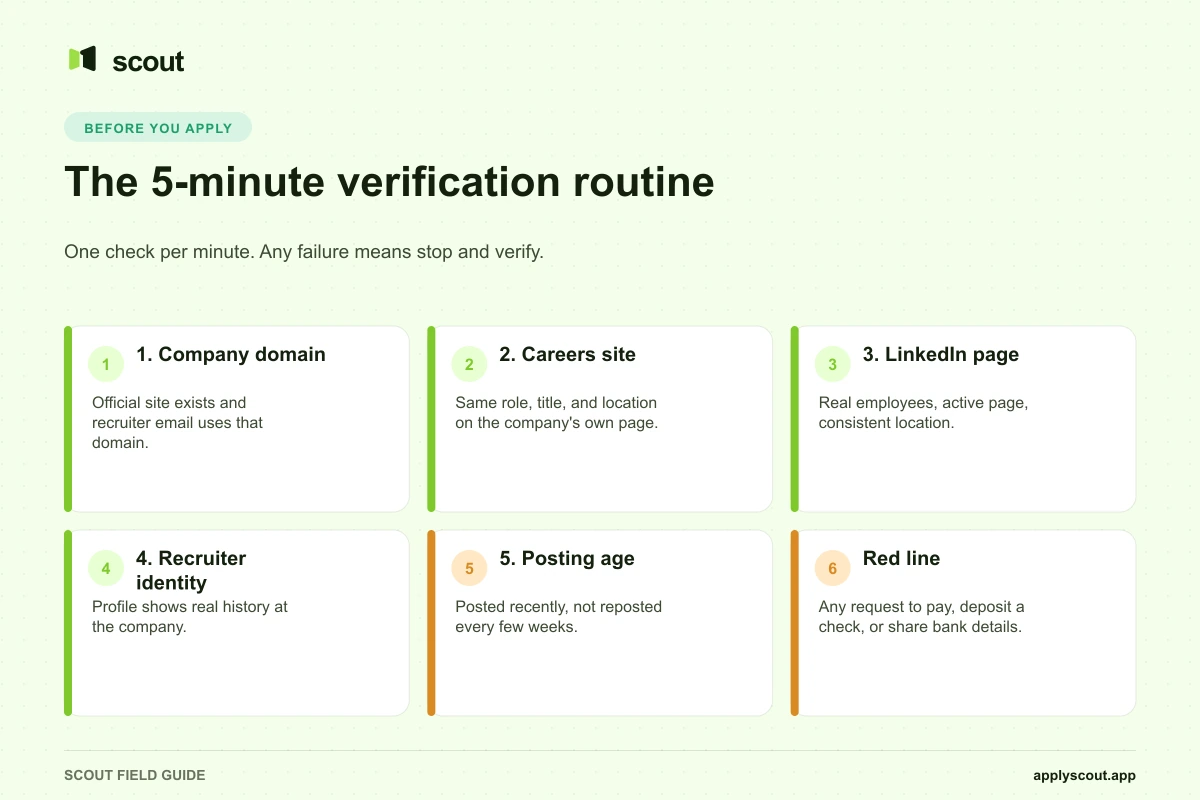
The 5-minute verification routine
Run this before you spend time tailoring anything.
| Minute | Check | Pass looks like | Fail looks like |
|---|---|---|---|
| 1 | Company domain. Search the company name on its own, then visit the official site. | Site exists, matches the posting, contact emails use that domain | No site, brand-new domain, or recruiter’s email domain doesn’t match |
| 2 | Careers site cross-check. Find the role on the company’s own careers page or ATS. | Same title, location, and ID on the official page | Only exists on a job board or social post |
| 3 | LinkedIn company page. Check employee count, recent posts, and whether people actually work there. | Real employees, active page, consistent location | No employees, recently created page, mismatched industry |
| 4 | Recruiter identity. Look up the person who contacted you. | Lists the company as current employer, real history, connections at the company | New profile, stock photo, no connection to the company |
| 5 | Posting age and reposts. Note the date, then search the exact title plus company. | Posted in the last few weeks, one live version | Months old, reposted repeatedly, or many near-identical copies |
The FBI recommends the same core checks in its job scam alert: search the company name alone, confirm the posting on the company’s official site, and never send money or banking details to an unverified employer. That alert also noted an average reported loss of nearly $3,000 per victim since early 2019.
If a recruiter reached out first, reply through the company’s official careers email or main phone line to confirm they work there. A real recruiter won’t mind. A scammer will vanish.
What to do if you’ve been scammed
Move fast and keep everything: messages, emails, payment receipts, profile links, and phone numbers.
- Contact your bank or payment provider right away. The FTC advises asking the company you used to send money to reverse the transaction if possible.
- Report it.
- US: File with the FTC at ReportFraud.ftc.gov and with the FBI at IC3.gov. Type ic3.gov directly. The FBI warned in July 2026 that criminals impersonate IC3 to re-target fraud victims with fake “recovery” offers.
- UK: Action Fraud has been replaced. Since December 4, 2025, you report fraud through Report Fraud, run by City of London Police, at reportfraud.police.uk or 0300 123 2040. In Scotland, report to Police Scotland on 101.
- Protect your identity. If you shared an ID, Social Security number, or bank login, place a fraud alert or credit freeze and change passwords.
- Report the posting to the job board or LinkedIn so it comes down for the next person.
- Ignore anyone offering to recover your money for a fee. That’s usually the second half of the same scam.
Where Scout fits
If you’re applying at volume, these checks add up. Scout’s Human Assistant gives you a dedicated person who finds matching roles and checks that each posting is recent and from a real company before applying. They also tailor your resume using your real experience and submit the application for you.
You talk with your assistant in a private WhatsApp group that you join after signing up and paying on Scout’s own site, which is the opposite of a stranger moving a “recruitment” chat off-platform. Your assistant never asks for deposits, bank details, or tasks. Your dashboard shows every job, the resume used, and screenshots of important form answers. That record also helps you check what was actually submitted. Plans start at $299 a month for Focused Search (250 applications a month), cancel anytime, with no placement fee or salary percentage. Scout doesn’t guarantee interviews. If you’d rather keep control and use software, the AI Assistant starts at $39 a month on the pricing page. And if you’re weighing automation tools, read how to stop auto-apply tools from applying to wrong jobs first.
FAQ
What is the fastest way to tell if a job posting is fake?
Find the same role on the company’s official careers page and confirm the recruiter’s email uses the company’s real domain. If either check fails, don’t send personal information until you’ve verified it another way.
Are ghost jobs illegal?
In most places, no. Ontario now requires employers with 25 or more employees to state whether a posting is for an existing vacancy, and New York’s S8877 would add disclosure and removal rules if the governor signs it.
Is it a scam if a recruiter contacts me on WhatsApp?
Not always, but it’s a strong warning sign, especially if the role involves “tasks,” crypto, or upfront deposits. The FTC specifically warns about unexpected job texts and WhatsApp messages.
Should I ever pay for a background check or equipment?
No. Legitimate employers pay for their own screening and equipment. A request to pay first, or to deposit a check and forward money, is a classic scam pattern.
How old is too old for a job posting?
There’s no fixed rule, but a posting that has been live for more than 30 to 60 days, or reposted repeatedly with identical text, is a lower-priority application. Apply if it’s a great fit, but don’t pour your best effort into it.
Where do I report a job scam in the UK now?
Use Report Fraud at reportfraud.police.uk or 0300 123 2040. It replaced Action Fraud in December 2025. In Scotland, call Police Scotland on 101.
Want someone to vet postings and apply for you? Book a call to see how Scout’s Human Assistant works.