How to Help Your Partner Find a Job (What Works)
By Scout Editorial Team · Published September 18, 2026
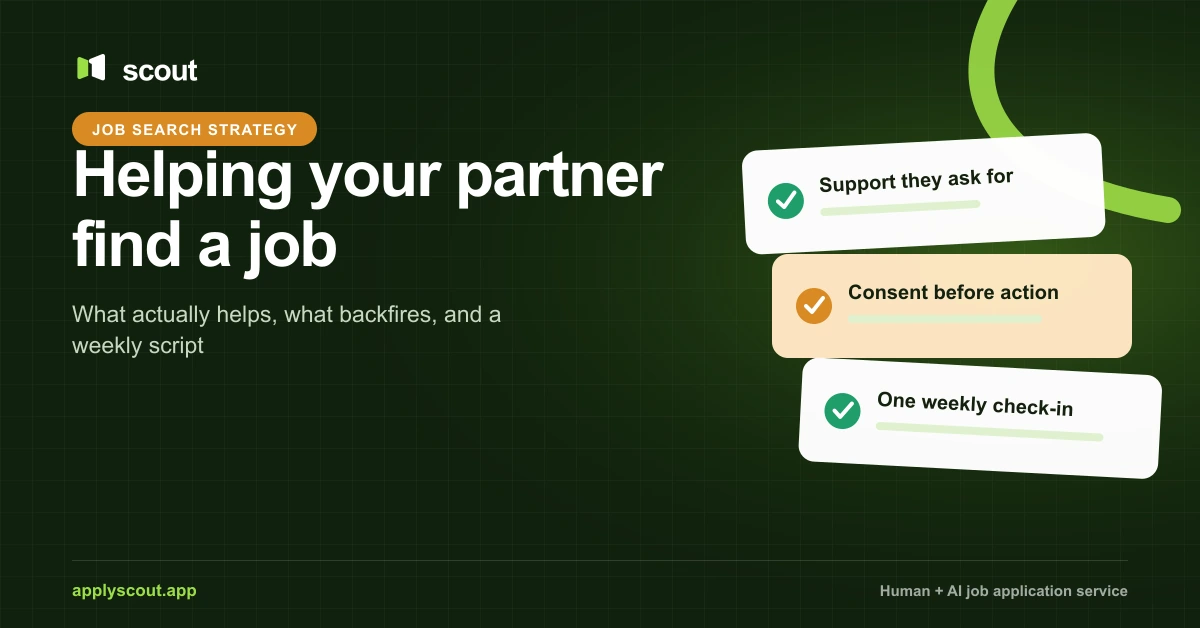
The best way to help your partner find a job is to offer specific, practical support they agree to, such as admin help, mock interviews, or introductions, while leaving the decisions and the applications in their name and under their control. Agree on one short weekly check-in so the search does not leak into every conversation. Criticism and pressure, even well meant, make things worse.
You probably already know the second part. The hard part is doing it when you are worried too. This guide gives you the roles that help, the moves that backfire, and a script for the weekly conversation.
Why your support matters more than you think
Job searching is hard on people, and on the people who live with them.
A large meta-analysis by Karsten Paul and Klaus Moser pooled 237 cross-sectional and 87 longitudinal studies and found that 34% of unemployed people had psychological problems, compared with 16% of employed people (published 2009). Another meta-analysis of 104 studies found that unemployed people had lower psychological and physical well-being, and that coping resources, including social and financial ones, were more strongly linked to mental health than demographics were (2005).
Social resources include you. You are not a bystander.
The couple-level research is sobering. A University of Michigan study followed 815 recently unemployed job seekers and their spouses or partners (1996). Financial strain raised depressive symptoms in both partners. That, in turn, led the partner to withdraw support and increase social undermining, such as criticism. Less support and more undermining then lowered relationship satisfaction and worsened depression further.
That is the trap: money stress makes you both feel worse, and feeling worse makes you less kind at exactly the wrong time. Knowing the pattern is half the defense.
The search itself also tends to run longer than people plan for. In August 2026 there were 7.0 million unemployed people in the U.S., and 1.9 million of them, 27.0%, had been looking for 27 weeks or more. If your partner’s search runs past six months, that is common, not a character flaw.
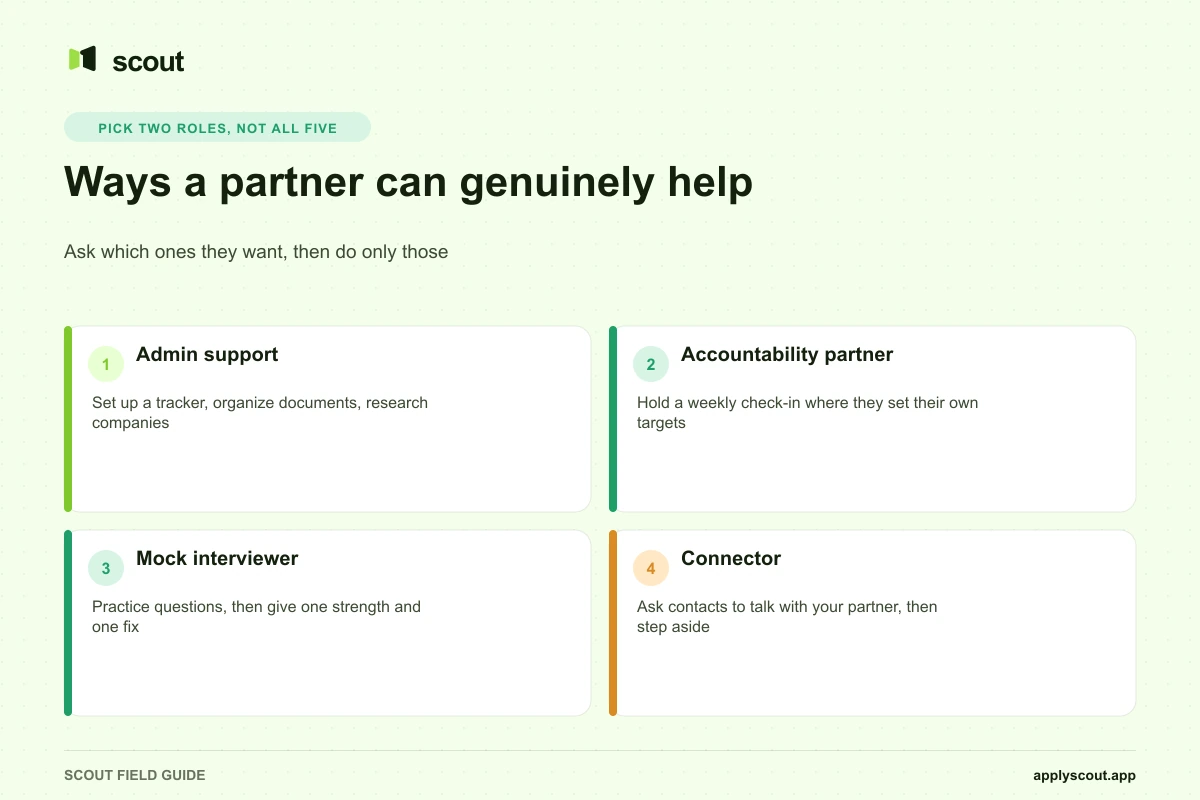
Roles that help (pick two, not all five)
Effort matters. A meta-analysis of job search research found that job search behavior was significantly and positively related to finding employment (2001). Your job is to make steady effort easier to sustain, not to supply the effort yourself.
Structured support works too. In a randomized field experiment with 1,801 participants, people who went through a job search workshop called JOBS had higher reemployment and income and fewer depressive symptoms two years later than a control group (2000). The benefits were largest for people who started out with low motivation and low sense of mastery. Structure helps most when confidence is lowest.
Ask your partner which of these they want. Then do only those.
| Role | What you actually do | Time per week | Watch out for |
|---|---|---|---|
| Admin support | Set up a tracking spreadsheet, organize documents, research company basics | 1 to 2 hours | Doing it so thoroughly they feel managed |
| Accountability partner | Hold the weekly check-in, help them set their own targets | 30 minutes | Turning check-ins into inspections |
| Mock interviewer | Run practice questions, give one strength and one fix | 1 hour | Critiquing their personality instead of their answers |
| Connector | Ask your contacts if they would talk to your partner, then step aside | As needed | Promising outcomes your contact never offered |
| Household buffer | Take on extra chores during heavy interview weeks | Varies | Keeping score about it later |
Two roles done reliably beat five done erratically.
What not to do
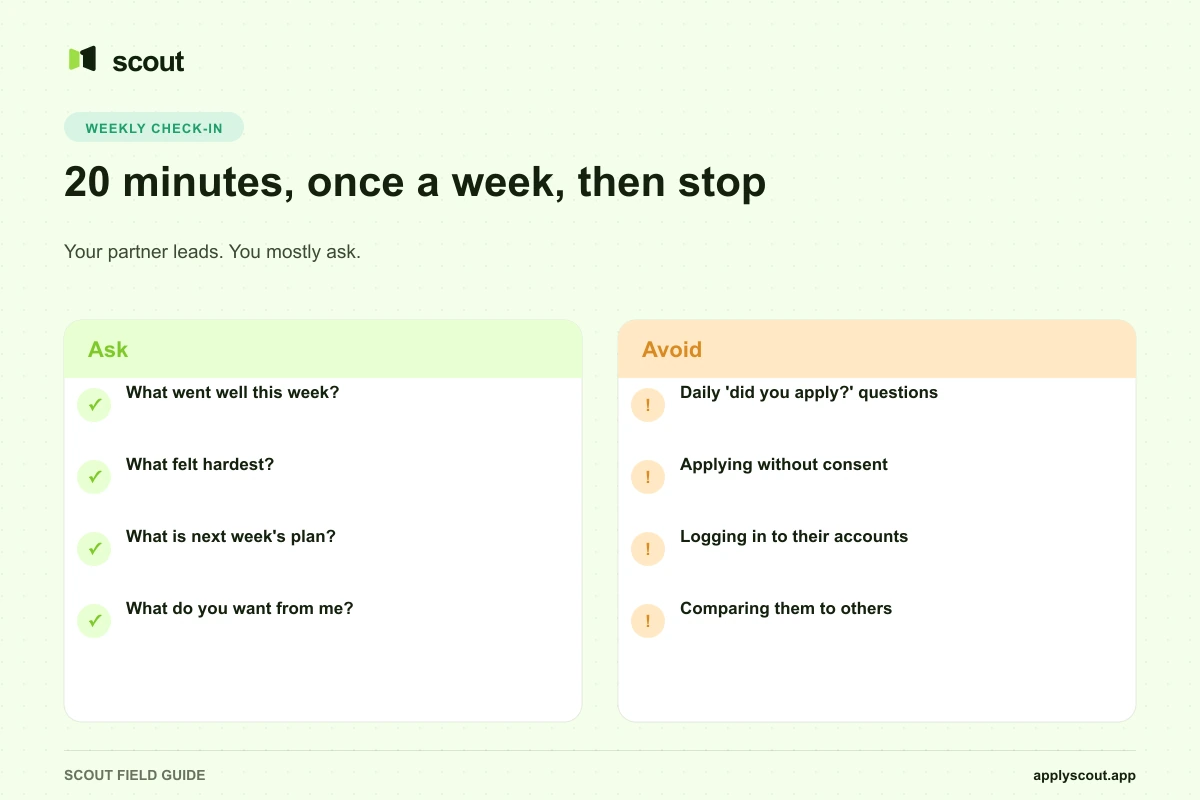
Do not apply to jobs without their consent. It sounds helpful. It is not. Every application is a promise made in their name, often with answers about salary, work authorization, or availability that only they can give. If an employer calls about a job they have never heard of, it damages their credibility and your trust.
Do not log in as them. LinkedIn’s User Agreement says members will keep their password a secret and will not share their account with anyone else. The same agreement requires one account in the member’s real name, a truthful profile, and no bots or unauthorized automated methods. Other job platforms have their own terms, so check before anyone touches an account that is not theirs.
Do not “improve” their resume with things that are not true. A stretched title or invented skill gets found out in an interview or a background check. Help them describe real work better. That is different, and it is allowed.
Do not nag. Asking “Did you apply anywhere today?” every evening is the undermining the Michigan study describes, even when it comes from love. Fold all of it into the weekly check-in.
Do not compare. “My coworker’s husband found something in three weeks” helps no one, and you do not know his story.
Consent and honesty, written down
If you are going to help hands-on, agree on rules first. Five minutes now prevents a hard conversation later.
Consent checklist (fill it in together):
- Which tasks you can do without asking (for example, saving job links into the tracker).
- Which tasks need a yes each time (for example, reaching out to a contact on their behalf).
- Which tasks are theirs alone (submitting applications, answering employer questions, negotiating).
- Which accounts you will never log in to.
- How they want feedback delivered (in writing, in person, only when asked).
Every application has to be truthful and authorized by the person applying. That rule applies to you, to a friend, and to any paid service.
The money conversation
This is the one couples avoid, and the one that drives most of the strain. Have it early, once, with numbers, and then stop relitigating it.
Cover four things:
- Runway. How many months can the household cover essentials with current savings and income? In 2025, both spouses were employed in 49.1% of married-couple families, and 5.7% of families included an unemployed person. If you were one of the dual-earner households, the budget may need real changes.
- Benefits. If your partner lost their job, check unemployment insurance right away. Each state runs its own program, claims go to the state where they worked, and the Department of Labor says the first payment generally takes two to three weeks after filing.
- Floor. What is the lowest salary or contract rate that keeps the household stable? Agree on it so a lowball offer becomes a math question, not a fight.
- Search budget. How much can go toward help, if anything, and for how long?
Then set a date to revisit, perhaps every 60 days. Between those dates, money talk is off the table unless something changes.
Paying for help: coach, resume writer, or application service
Sometimes the most supportive thing is to stop being the help and pay for it, so you can go back to being the partner. The three options solve different problems.
| Option | Solves | Look for | Avoid |
|---|---|---|---|
| Career coach | Direction, confidence, interview skills, negotiation | Relevant industry experience; a credential such as ICF’s, whose entry level requires 60+ hours of coach education and 100+ hours of coaching experience | Vague packages with no defined sessions |
| Resume writer | A clear story on paper | Samples in your partner’s field, a revision policy | Anyone who adds experience your partner does not have |
| Application service | The hours spent finding roles and applying | Evidence of each application, clear limits, cancel terms | Job or interview guarantees, upfront “placement” fees |
On that last column: the FTC warns that honest employers will never ask you to pay to get a job, and that if a placement firm asks a candidate for a fee, especially in advance, you should walk away. A legitimate service sells disclosed labor or software, not access to employers.
For a longer comparison of these options, see reverse recruiter vs career coach vs job application service and job search concierge vs reverse recruiter.
Where Scout fits
If the applying is what is wearing your partner down, and you have been tempted to do it for them, Scout’s Human Assistant is built for that job, with your partner in charge.
A dedicated human assistant finds roles that match your partner’s preferences, tailors their resume using their real experience (never inventing anything), and applies for them. Your partner talks with the assistant in a private WhatsApp group, and a dashboard shows each job, the resume used, and screenshots of important answers, so nobody has to wonder what was sent. Monthly plans start at $299 for Focused Search with 250 applications a month, and you can cancel anytime. The Career Campaign plan at $999 a month adds a second assistant and up to four job profiles, useful if your partner is pursuing two different kinds of roles. There is no placement fee or salary percentage, and no interview guarantee. The AI Assistant starts at $39 a month for people who prefer software. See current options on the pricing page.
One firm rule: your partner has to be the one who signs up, consents, and provides accurate information. You can suggest it; you cannot do it for them. If they are not sure what role to target, they can book a free 15-minute call to define it first.
A weekly check-in script
Once a week, same time, 20 minutes, with something to drink. No phones. Your partner leads, and you mostly ask.
Copy this:
- “What went well this week, even if it was small?”
- “What felt hardest?”
- “What are you planning for next week? What number feels realistic to you?”
- “Is there one thing you want from me this week? Or one thing you want me to stop doing?”
- “Anything on money we need to adjust, or are we good until our next review?”
- “Okay. Job talk is done until next week. What do you want to do tonight?”
The last line matters most. The check-in works because it contains the topic. If job talk spills into every dinner, the search starts to own the relationship.
If your partner seems persistently hopeless, stops sleeping or eating normally, or mentions self-harm, step out of the coach role and encourage them to talk to a doctor or mental health professional. In the U.S., you can call or text 988 to reach the 988 Suicide & Crisis Lifeline, available around the clock.
FAQ
How do I help my partner find a job without nagging?
Replace daily questions with one weekly check-in that your partner leads. Agree in advance what you will help with, then do only that, and keep job talk out of the rest of the week.
Can I apply to jobs on my partner’s behalf?
Only with their explicit consent for each application, using accurate information they have approved, and without logging in to their personal accounts. Platforms such as LinkedIn prohibit account sharing. In most cases it is better for your partner to submit applications themselves or use a service they have signed up for directly.
Should I pay for a career coach or a job application service for my partner?
Ask what problem you are trying to solve. A coach helps with direction and interviewing. An application service handles the time spent finding roles and submitting. Your partner should choose and sign up, since they will be working with the provider. Our guide on paying someone to apply for jobs covers what to check.
My partner has been searching for months. Is something wrong?
Not necessarily. In August 2026, 27.0% of unemployed people in the U.S. had been looking for 27 weeks or more. Long searches are common. Review the target role and the materials together, and consider outside help if the same approach keeps producing silence.
How do we talk about money without fighting?
Have one structured conversation that covers runway, benefits, a salary floor, and a search budget. Write the numbers down and schedule the next review. Outside those reviews, leave money out of it unless something changes.
What if my partner does not want my help?
Respect it. Offer the household buffer role quietly, keep the weekly check-in optional, and let them know the offer stands. Support they did not ask for usually lands as pressure.
The most useful thing you can be during a job search is steady. When your partner is ready to hand off the applying itself, Scout’s Human Assistant can carry that load while they stay in control.