What Job Should I Do Next? How to Pick a Target Role
By Scout Editorial Team · Published September 15, 2026
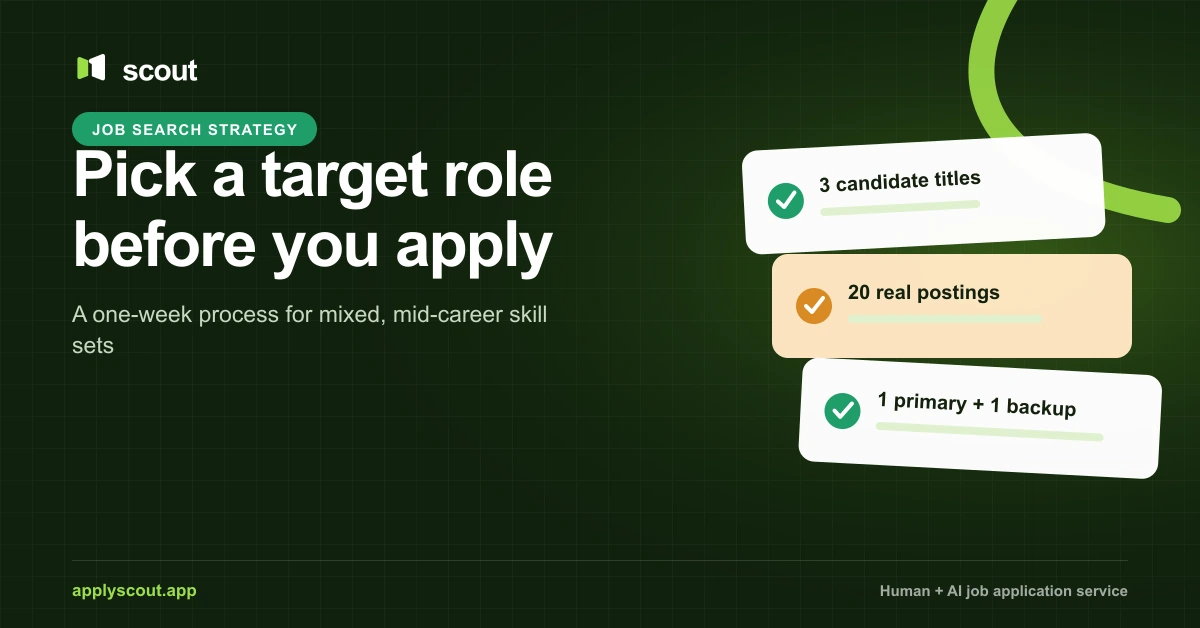
If you are asking “what job should I do next,” stop browsing and spend one week testing three specific job titles against real postings and real people. Pick the title where your proven skills match the most repeated requirements, then name one backup. Apply only after you can describe your target in a single sentence that a recruiter would recognize.
The rest of this guide shows you how, with a worksheet you can copy.
Why “I’m open to anything” hurts your search
Mixed backgrounds are normal. The Bureau of Labor Statistics follows a group of people born from 1957 to 1964, and they held an average of 12.9 jobs from ages 18 to 58, with 2.9 jobs on average between ages 35 and 44 (latest interviews 2022 to 2023). Plenty of mid-career people have a resume that zigzags.
You may have heard that people change careers five to seven times. BLS says it has never attempted to estimate the number of times people change careers, because nobody agrees on what counts as a career change. So ignore that number. What matters is whether your next employer can see a clear fit.
Staying open sounds flexible, but hiring still runs on job titles. Recruiters search them and job alerts trigger on them. Skills-first hiring sounds like it should rescue the generalist, and LinkedIn’s research finds that talent pools expand nearly 10x on average when employers screen on skills. But a joint report from Harvard Business School’s Project on Managing the Future of Work and the Burning Glass Institute found that the change had shown up in not even 1 in 700 hires the year before its February 2024 publication.
Translation: employers say they want skills, but most still screen on a recognizable title and the keywords that go with it. You have to do the translating for them.
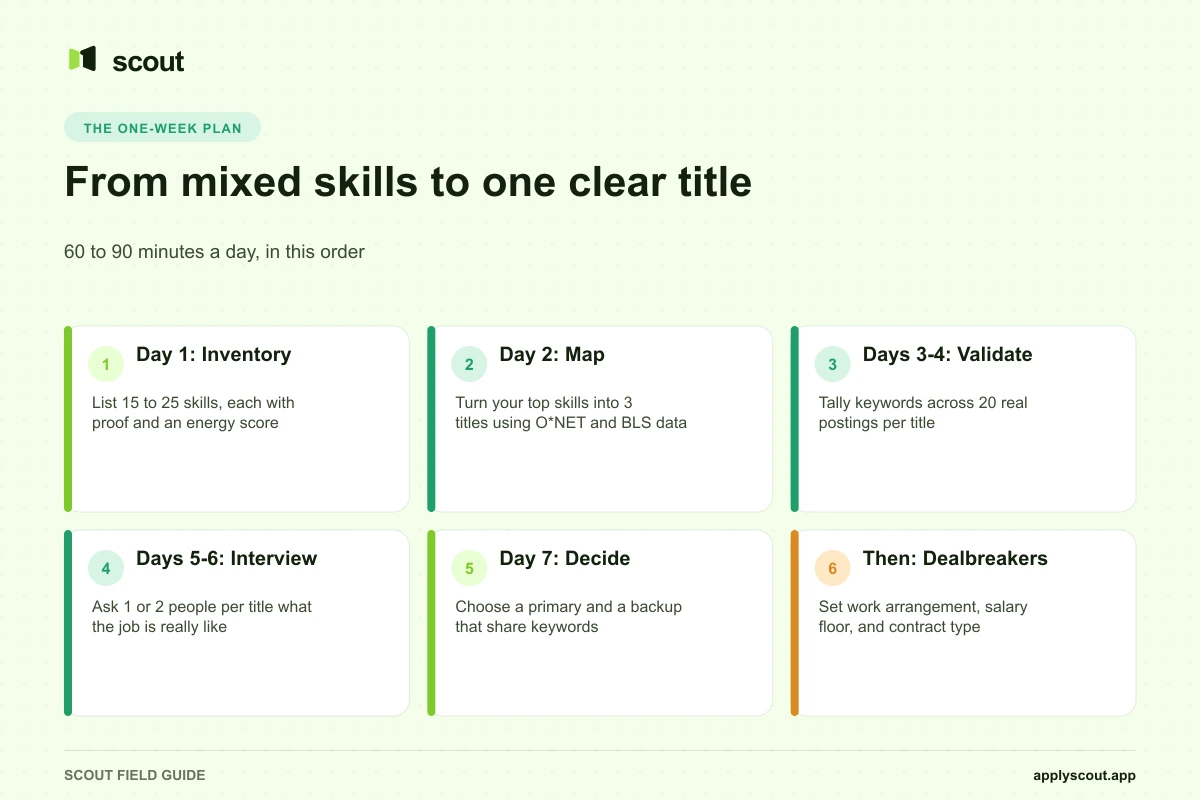
The one-week plan at a glance
| Day | Task | Output |
|---|---|---|
| 1 | Inventory your skills and proof | A list of 15 to 25 skills, each with evidence |
| 2 | Map skills to 3 candidate titles | Three titles with O*NET and BLS notes |
| 3 to 4 | Pull 20 real postings | A keyword frequency table |
| 5 to 6 | Run 3 to 5 informational interviews | Notes on what the job is really like |
| 7 | Pick primary and backup, write dealbreakers | A one-page target profile |
Block 60 to 90 minutes a day. Short on time? Stretch it to two weeks, but keep the order.
Day 1: Inventory your skills, with receipts
Open a spreadsheet. Make three columns: skill, evidence, and energy.
- Skill is a noun a job posting would use. “Brand guidelines,” “pricing analysis,” “Figma,” “stakeholder presentations.” Not “creative” or “people person.”
- Evidence is the proof. A project, a number, a tool, a deliverable. If you cannot name the evidence, the skill is a hope, not a skill.
- Energy is a 1 to 5 score for how much you want to keep doing it. People skip this column and then land a job built around the thing they are tired of.
Aim for 15 to 25 rows, then highlight the five with strong evidence and high energy.
Two free tools help when you are stuck. The O*NET Interest Profiler on My Next Move asks about the kinds of work you enjoy and suggests careers that match your interest profile. ONET’s developer documentation lists both a 30-question “Mini-IP” and a 60-question version for when accuracy matters more than speed. Take the longer one. And ONET’s soft skills search lets you tick skills such as negotiation, persuasion, or complex problem solving and returns occupations that use them.
Treat both as prompts, not verdicts.
Day 2: Map your skills to three candidate titles
Now turn the five strongest skills into job titles. Three is the right number. One is a guess, and ten is a mood board.
Start at O*NET OnLine. It covers 1,016 occupation titles and has a few searches that suit career changers: Job Duties search (paste what you actually did and see which occupations do similar work), Software Skills search (enter tools like Tableau or Adobe Illustrator), and a Bright Outlook filter for occupations expected to grow quickly or have many openings.
Each occupation page has two sections worth copying into your notes:
- Sample job titles. The Marketing Managers profile, for example, lists titles such as Brand Manager, Marketing Communications Manager, and Product Manager. These are the words to search on job boards.
- Related occupations. The same page links to Market Research Analysts and Marketing Specialists, Public Relations Managers, and Business Intelligence Analysts. This is where hybrid careers hide.
Then check pay and direction in the Bureau of Labor Statistics Occupational Outlook Handbook. Use median pay and projected growth as a sanity check, not a decision. A few examples from the current edition:
| Occupation | Median pay (May 2025) | Projected change, 2025 to 2035 |
|---|---|---|
| Marketing managers | $166,790 | 7% |
| Advertising and promotions managers | $133,660 | -4% |
| Market research analysts | $78,760 | 7%, about 82,000 openings a year |
| Graphic designers | $62,960 | -2%, about 16,000 openings a year |
For a designer who also likes numbers, the message is clear: pure design work is projected to shrink slightly, while roles pairing creative judgment with business or analysis are projected to grow. Your design skill may be worth more inside a hybrid title.
Days 3 and 4: Validate with 20 real postings
This is the step most people skip, and it is the one that saves you months.
For each of your three titles, pull about 20 current postings that match your location rules. On LinkedIn you can filter search results to Remote and turn on job alerts for the saved search, which makes collecting easier. Mix company sizes. Skip postings that are obviously a different seniority level.
Paste each posting’s requirements into a document and count how often each skill, tool, or phrase appears. A spreadsheet tally is enough.
Keyword frequency template (one per title):
| Keyword or requirement | Postings mentioning it (out of 20) | Do I have proof? (Y / partly / N) | Evidence I would cite |
|---|---|---|---|
| e.g. “brand strategy” | 16 | Y | Rebrand for a 40-store retailer |
| e.g. “SQL” | 11 | N | None yet |
| e.g. “go-to-market” | 9 | Partly | Launch plan for one product line |
Score each title with one number: the share of keywords that appear in 10 or more postings where you answered Y. If you hit 60% or more, the title is realistic now. Between 40% and 60%, it is realistic with a well-tailored resume. Under 40%, it is a growth goal, not a target for this search.
Note the surprises, usually tools. O*NET’s page for Market Research Analysts and Marketing Specialists lists technologies as varied as Tableau, Google Analytics, Salesforce, Canva, and Adobe Creative Cloud. If you know the design tools and are weak on analytics tools, that is a fixable gap, and now you know exactly which one.
Days 5 and 6: Test with informational interviews
Postings tell you what a company asks for. People tell you what the job is. The BLS career-change guidance puts it simply: once you find people in an occupation that interests you, talk to them about their work, and bring questions ready.
Find one or two people per title through former colleagues, second-degree LinkedIn connections, or alumni groups. Ask for 20 minutes and make clear you are not asking for a job.
Message you can copy:
Hi Dana, I’m a designer moving toward brand marketing, and your path from agency design to brand management is close to what I’m considering. Could I ask you four or five questions over a 20-minute call in the next two weeks? I’m not asking about openings. I’m trying to understand the day-to-day before I commit to a direction.
Questions that actually separate titles:
- What did you spend most of last week doing?
- Which skills from your old role turned out to matter most here?
- What do people get wrong about this job before they start?
- Is remote or hybrid realistic at the level I’m aiming for?
Write down one sentence after each call: “This role is mostly ___.” If that sentence makes you tired, believe it.
Day 7: Pick a primary, a backup, and your dealbreakers
Now decide. Your primary title is the one with the best mix of keyword match, interview feedback, and energy. Your backup is a title that shares most of the same keywords, so one resume can be adapted for both without starting over.
Then write your dealbreakers. Vague preferences turn into wasted applications.
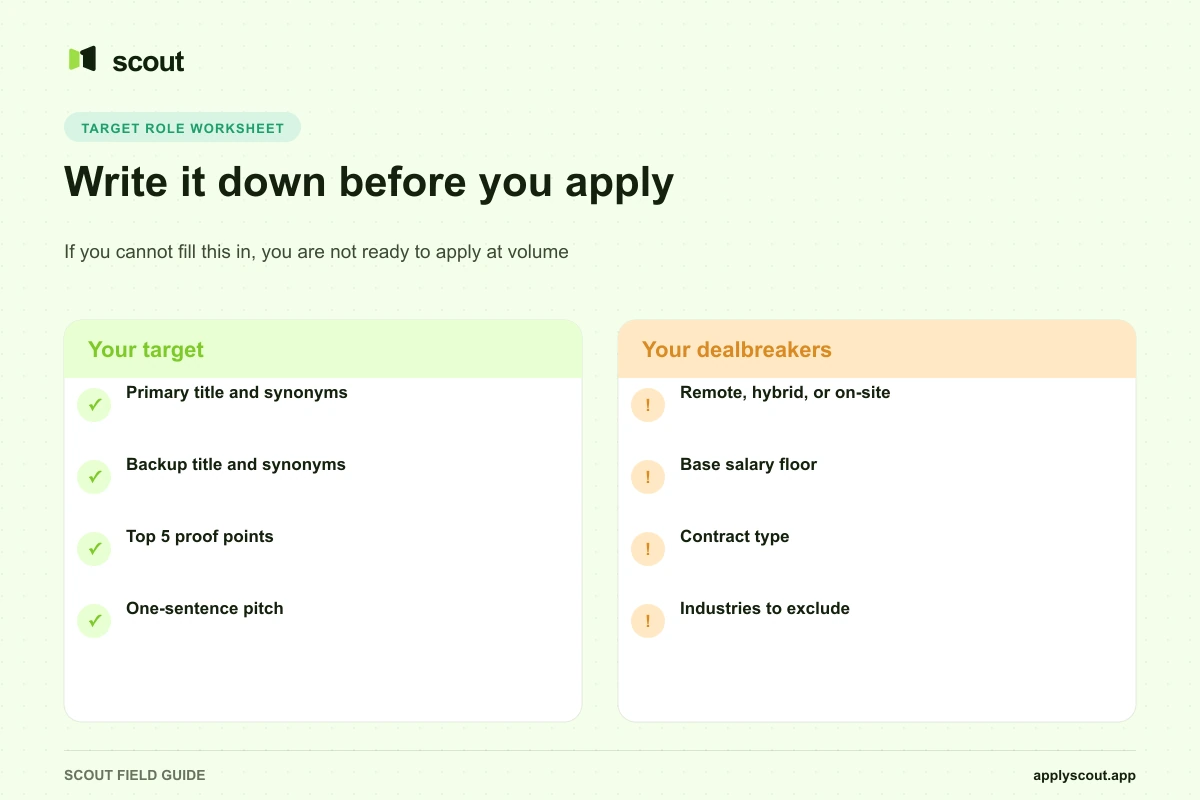
Target role worksheet (copy this):
| Field | Your answer |
|---|---|
| Primary title (and 2 to 3 synonyms) | |
| Backup title (and 2 to 3 synonyms) | |
| Seniority level | |
| Work arrangement (remote / hybrid / on-site, and max commute) | |
| Salary floor (base) | |
| Contract type (full-time, contract, contract-to-hire) | |
| Industries to target | |
| Industries or companies to exclude | |
| Top 5 proof points for the resume | |
| One-sentence pitch |
The one-sentence pitch is the test. “I’m a brand marketing manager who turns design instincts into campaigns that move revenue, looking for a hybrid role in consumer goods.” If you cannot write that sentence yet, you are not ready to apply at volume.
A worked example (hypothetical)
This is an illustration, not a real person. Imagine Priya, nine years in, with a graphic design degree, five years as an in-house designer at a retailer, and the last three years doing a blend of creative direction, sales reporting, and helping buyers decide which product lines to push. She wants hybrid or remote work and a base salary above her current one.
Her Day 1 inventory highlights brand systems, campaign creative, Excel reporting, vendor presentations, and assortment planning. Day 2 gives her three candidates:
- Brand Marketing Manager. Uses the brand and campaign work directly.
- Product Marketing Manager. Uses positioning and launch work, but postings lean toward software companies.
- Merchandising Analyst. Uses the reporting and assortment work, with less creative input.
Her 20-posting tally might look like this:
| Title | Keywords she can prove | Surprise requirement | Interview takeaway |
|---|---|---|---|
| Brand Marketing Manager | High | Budget ownership | ”Your retail design work reads as brand experience” |
| Product Marketing Manager | Medium | Customer research, SaaS experience | ”Hard without a tech launch on your resume” |
| Merchandising Analyst | Medium | SQL, forecasting tools | ”Lots of spreadsheets, little creative work” |
She picks Brand Marketing Manager as primary, with Merchandising Analyst as the backup because it shares her retail and reporting proof. Product Marketing goes on a later list, after she leads a launch. Her dealbreakers: hybrid at most two days a week in office, a base salary floor she sets herself, full-time only.
What she did not do: apply to all three with one generic resume, spreading thin evidence across three stories.
Where Scout fits once you have a target
Choosing the role is your job. Applying consistently is where many people stall, because tailoring each resume takes hours.
Scout’s Human Assistant gives you a dedicated person who finds roles that match the preferences you set, tailors your resume using your real experience (it never invents anything), and applies on your behalf. You talk in a private WhatsApp group, and a dashboard shows each job, the resume used, and screenshots of important answers. Plans start at $299 a month for Focused Search with 250 applications a month, and you can cancel anytime. If your week ends with two genuinely different targets, the Career Campaign plan at $999 a month includes two assistants and up to four job profiles, so a primary and a backup can each have their own resume. There is no placement fee or salary percentage, and no service can honestly guarantee interviews. You still provide accurate information and approve the search. Prefer software? The AI Assistant starts at $39 a month. Compare options on the pricing page.
If you are still torn between two titles, a free 15-minute call can help you pin down the target before anything is sent. Book a call here. For more on how the work is split, see how Scout works and our comparison of human and AI application services.
FAQ
What job should I do next if I have mixed skills?
Pick the title where your strongest proven skills match the requirements that appear most often in real postings. Run the 20-posting tally for three candidates and choose the one with the highest match, then add a backup that shares most of the same keywords.
How many target roles should I apply for at once?
One primary and one backup suits most people. More usually means a generic resume. If you truly need two directions, give each its own resume and company list.
Are career quizzes like the O*NET Interest Profiler accurate?
They are good at generating ideas. They cannot judge your evidence, salary needs, or local demand, so validate suggestions with postings and conversations.
Do employers really hire on skills instead of titles now?
Some do, and skills-first screening can widen the pool considerably. But the Harvard Business School and Burning Glass Institute research shows actual hiring changes have been small. Write your resume so a title-based screen and a skills-based screen both find what they are looking for.
What if none of my three titles scores well?
Go back to Day 2 and look one step sideways using O*NET’s related occupations. If every option scores under 40%, pick the closest title, build the single most-repeated missing skill, and apply to roles one level below your target while you do.
Can someone else apply to jobs for me while I figure this out?
Only after the target is clear. Delegating applications before you know your role just speeds up the wrong search. Once it is defined, read our guide on paying someone to apply for jobs for you and how to stop auto-apply tools from applying to the wrong jobs.
Know your target, then make every application point at it. When you are ready for help with the applying part, Scout’s Human Assistant can take it from there.