How Many Jobs Should You Apply to per Week?
By Scout Editorial Team · Published September 30, 2026
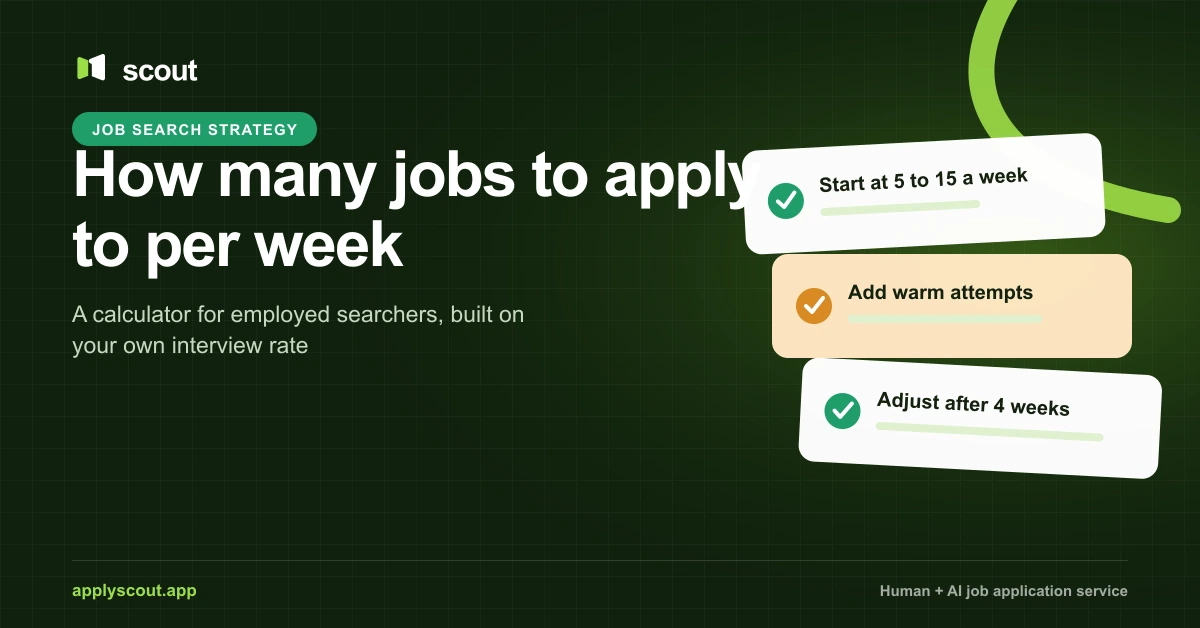
If you have a job, a sensible starting point is 5 to 15 well-matched applications per week, plus one or two referral or networking attempts. The right number for you is not a rule of thumb. It is the number of qualified applications needed to produce the interviews you want, divided by the weeks you are willing to search. Start in the middle of the range, measure your own interview rate for four weeks, then use the calculator below to adjust.
That answer is deliberately narrow. Being employed changes the math. You have less time, but you also convert better and can afford to be choosier, so the goal is a steady pipeline that fits around your day job, not a sprint that burns out in three weeks.
Why the old “apply to everything” advice is weaker now
Employers are receiving far more applications than a few years ago, which changes how much any single cold application is worth.
- Ashby, an applicant tracking system, reported in May 2026 that applications per hire have tripled since 2021, with roles now receiving more than 300 applications per hire on average. The same release says candidates are roughly 50% less likely to receive an interview than five years ago.
- Greenhouse’s benchmark data, covering more than 6,000 companies, shows 244 applications per job in 2025, up 111% from 116 in 2022. Its time-to-fill figure rose to 59.67 days in 2025, from 43.64 in 2022.
Two conclusions follow. First, each cold application has a lower expected value than it used to, so a handful per week will feel slow. Second, spraying applications at loosely matched roles adds to the pile without moving you up it. Both point toward a moderate, well-targeted volume plus channels that skip the pile.
The labor market context, briefly
The macro picture is neither booming nor collapsing. In the BLS Job Openings and Labor Turnover Survey for August 2026, job openings were little changed at 7.1 million, hires at 5.2 million, and quits at 3.1 million. The August 2026 jobs report counted 7.0 million unemployed people, so there was roughly one opening per unemployed person that month. That is a balanced market, not a candidate’s market.
Search length is harder to measure for employed people because no official series tracks it. The closest proxy is unemployment duration: in August 2026, BLS reported a median duration of 11.4 weeks and a mean of 26.3 weeks. Treat that as a rough guide only. It measures spells of unemployment, not searches by people with jobs, and the gap between median and mean tells you a minority of searches run very long. Planning for three months of steady effort, with a buffer for six, is realistic.
The good news: employed searchers convert better
The research on on-the-job search is encouraging. Economists at the New York Fed and elsewhere found that the employed are about four times more efficient than the unemployed in job search, measured as results per unit of search effort. A related New York Fed analysis of 2013 to 2016 survey data found that roughly one in ten employed job seekers received at least one offer in a four-week period, despite searching far less intensively than unemployed seekers.
Sentiment is softer right now. The New York Fed’s July 2026 SCE Labor Market Survey found 24.9% of respondents had searched for a job in the past four weeks, and the average expected chance of receiving at least one offer in the next four months fell to 18.0%, the lowest since March 2021. More people looking, less optimism about offers. Another reason to plan for a steady pace rather than a short burst.
Referrals change the math more than volume does
If you can get a referral, one referred application can be worth several cold ones. Ashby’s referral analysis of 38 million applications found referrals made up about 1% of applications from 2021 to 2024, but 16% of interviewed referred candidates received offers versus 6% of interviewed inbound candidates. Its recruiting operations benchmarks add that 52% of referred candidates pass initial screens, compared with 35% overall.
So your weekly number should have two parts: cold applications and warm attempts. A warm attempt is a referral request, a message to a hiring manager you have a real connection to, or a recruiter you have worked with before. Even one a week compounds.
The calculator: work backward from interviews
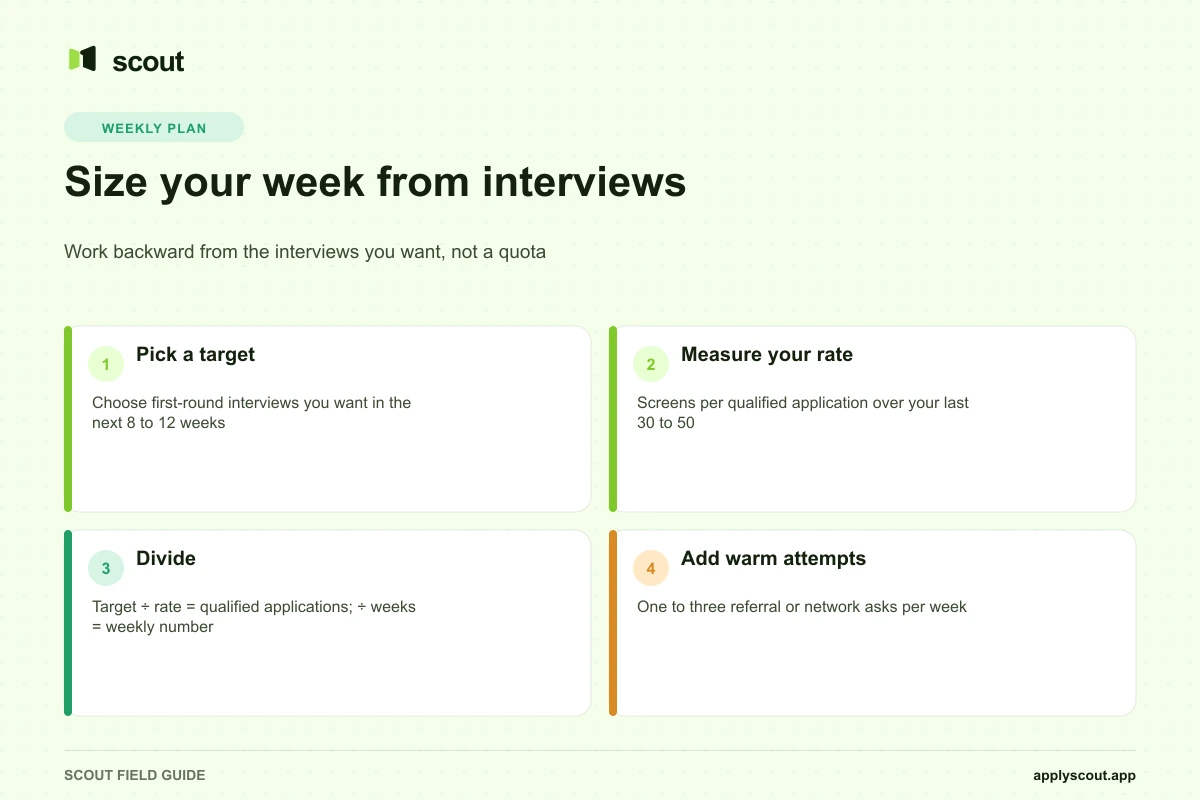
Forget the weekly number for a moment and decide how many first-round interviews you want in a given window. Then:
Qualified applications needed = target interviews ÷ your interview rate
Applications per week = qualified applications needed ÷ weeks in the window
“Interview rate” here means first-round interviews or recruiter screens per qualified application, measured on your own last 30 to 50 applications. The guide to application volume versus interview rate explains how to define a qualified application and how to avoid inflating the rate, so I will not repeat it here.
Worked example 1 (illustrative). You want four first-round interviews over the next eight weeks. Your last 50 qualified applications produced two screens, a 4% rate.
- 4 ÷ 0.04 = 100 qualified applications
- 100 ÷ 8 weeks = 12.5 per week
Twelve or thirteen a week is achievable for an employed person if the search is well defined, but it is a real workload. If that is too much, lengthen the window to 12 weeks (about 8 per week) or raise your rate.
Worked example 2 (illustrative). A senior specialist sees a 10% rate because fewer people fit their roles. They want three interviews in eight weeks.
- 3 ÷ 0.10 = 30 qualified applications
- 30 ÷ 8 = about 4 per week
That is why senior, niche searches often run on lower weekly numbers. The supply of matching roles is small, and each one deserves more effort.
No data yet? Assume 3% for broad roles and 6% for niche roles where you are clearly qualified, then replace the assumption with your real number after four weeks. Those starting assumptions are planning placeholders, not benchmarks.
Recommended ranges by situation
| Situation | Cold applications per week | Warm attempts per week | Why |
|---|---|---|---|
| Senior or niche specialist | 3 to 6 | 2 to 3 | Few matching roles; each needs tailoring; referrals carry more weight |
| Mid-level, common role family | 8 to 15 | 1 to 2 | Steady supply; tailoring can be partly templated |
| Entry level or broad role | 12 to 25 | 1 | Large applicant pools, lower rates per application |
| Career pivot | 5 to 10 | 2 to 4 | Cold applications convert poorly; warm paths matter most |
| Heavy work season | 3 to 5 | 1 | Keep the pipeline alive without dropping it |
These ranges are practitioner judgment for planning, not research findings. Your interview rate overrides them. Senior roles also take longer to close: Ashby reports a median of 71 days to fill senior roles versus 52 for junior roles, so a smaller weekly count with a longer horizon is normal at that level.
A weekly plan that fits around a job
Here is a plan for a mid-level search at about 10 cold applications and two warm attempts a week, on roughly five hours. The guide to job searching while working full time covers the time budget itself; this is the application slice.
| Day | Block | Output |
|---|---|---|
| Monday evening | 45 min: review new postings, shortlist | 12 to 15 shortlisted roles |
| Tuesday morning | 60 min: tailor and submit | 4 applications |
| Wednesday lunch | 20 min: one referral or warm message | 1 warm attempt |
| Thursday evening | 60 min: tailor and submit | 4 applications |
| Saturday morning | 60 min: final batch, update tracker | 2 applications, 1 warm attempt, weekly review |
Batch the work. Context switching between “find” and “apply” is where evenings disappear. If the volume you need is larger than your time allows, read how to apply to hundreds of jobs without losing accuracy before you scale.
When to increase or decrease
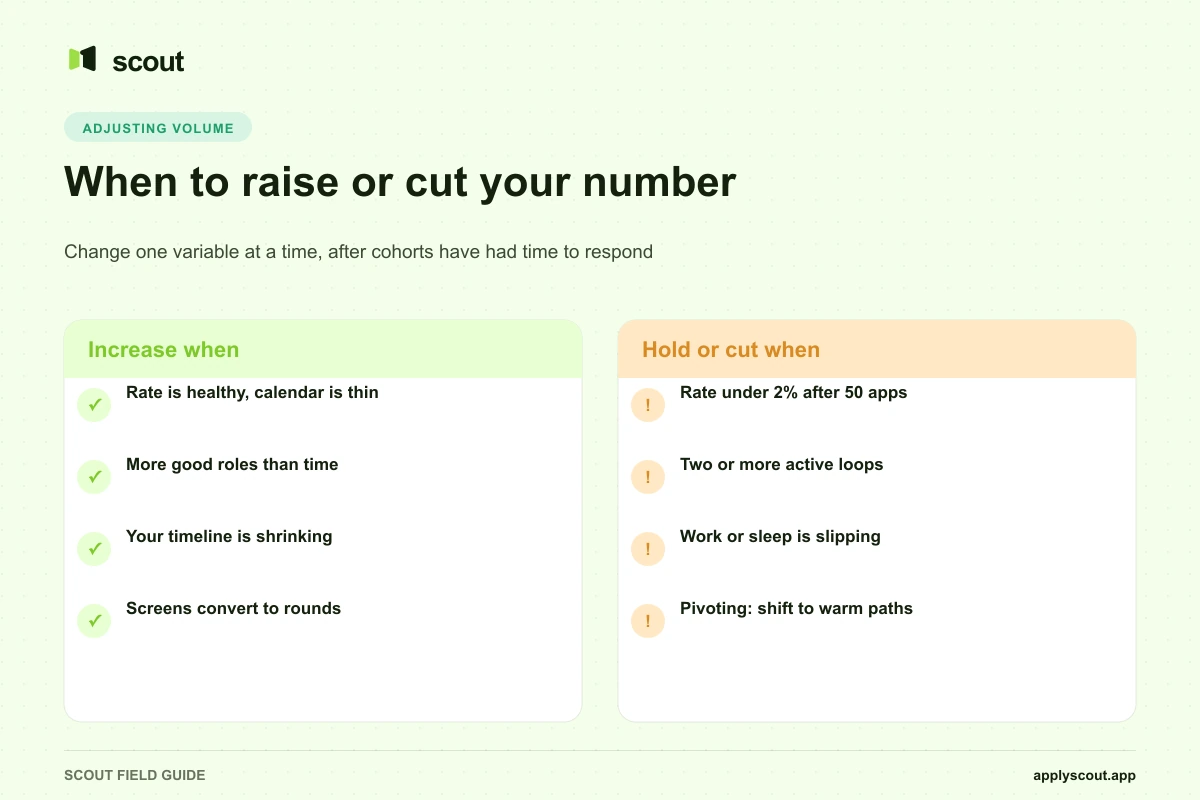
Change one thing at a time, and only after a cohort has had two to three weeks to get responses.
Increase volume when:
- Your interview rate is healthy (at or above your planning assumption) but you have too few interviews in the calendar.
- You keep finding more roles that pass your hard filters than you have time to submit.
- Your target window is shrinking, for example because of a reorg at your current employer.
Hold or decrease volume when:
- Your rate is below 2% after 50 qualified applications. More of the same will mostly produce more rejections. Fix targeting, resume evidence, or seniority level first.
- You are in two or more active interview loops. Preparation beats new applications at that point.
- Your work quality or sleep is slipping. A search that costs you your current job’s standing is a bad trade.
Shift the mix toward warm attempts when cold applications produce screens but rarely second rounds, or when you are pivoting fields.
Tracking sheet columns
You only need a simple spreadsheet. These columns are enough to run the calculator every Friday:
| Column | Example | Why it matters |
|---|---|---|
| Date applied | 2026-10-06 | Cohort age for response windows |
| Company | Example Co | Duplicate checks |
| Role title and requisition ID | Senior Analyst, R-1042 | Prevents reapplying to the same opening |
| Posting age when applied | 2 days | Early versus late applications |
| Channel | Cold, referral, recruiter | Channel-level rates |
| Resume version | Analytics v3 | Which version converts |
| Qualified (Y/N) | Y | Denominator for your rate |
| Status | Applied, screen, interview, rejected | Outcome tracking |
| Date of first response | 2026-10-14 | Typical lag in your market |
| Notes | Asked about visa | Follow-up context |
The requisition ID column does more work than people expect. Reapplying to the same opening through a different board looks careless to a recruiter. The duplicate application guide has a simple matching method.
Where Scout fits
If the math says you need 12 a week and your calendar says 4, the gap is labor, not motivation. Scout’s Human Assistant gives you a dedicated human assistant who finds roles matching your preferences, checks new postings in batches through the day, tailors your resume using your real experience (never invented), and applies for you. You talk in a WhatsApp group, and a dashboard shows each job, the resume used, and screenshots of important answers, so your tracking sheet largely fills itself.
Plans are monthly from $299 for Focused Search (250 applications per month), cancel anytime, with no placement fee or salary percentage. Scout does not guarantee interviews, and the volume you choose should still come from your own interview rate. If you want lighter help, the AI Assistant starts at $39 per month. Plans are on the pricing page.
FAQ
Is 10 applications a week enough?
For a mid-level employed searcher with a 3% to 5% interview rate, 10 a week produces roughly one to two first-round interviews every three to four weeks. That is enough if you are patient and adding referrals. If you need interviews faster, raise the rate before you raise the count.
Should I apply to jobs I’m only partly qualified for?
Yes, if you meet the core requirements and can show evidence for them. Count those applications in your qualified total only if they meet your own hard rules for role, level, location, and authorization.
How many applications does it take to get one job?
There is no reliable universal figure, and widely shared numbers often lack a traceable source. Employer-side data shows hundreds of applications per hire across all candidates, but your personal number depends on fit, channel, and seniority. Measure your own rate.
Does applying to more jobs lower the quality of each application?
Past a certain point, yes. When tailoring drops to zero and targeting loosens, interview rates usually fall. That is why the calculator uses qualified applications rather than total submissions.
How long should I keep the same weekly number before changing it?
Four weeks is a good minimum. Applications need two to three weeks to draw responses, so judging a new plan after one week mostly measures noise.
Should I apply on weekends?
It is fine to apply whenever your schedule allows. Timing within the posting’s life matters more than the day of the week; see the guide on the best time to apply for jobs for what the evidence actually supports.
Pick your target interviews, plug in your rate, and let the number come from your data. If you want to talk through the plan, you can book a call.