How to Job Search While Working Full Time
By Scout Editorial Team · Published August 28, 2026
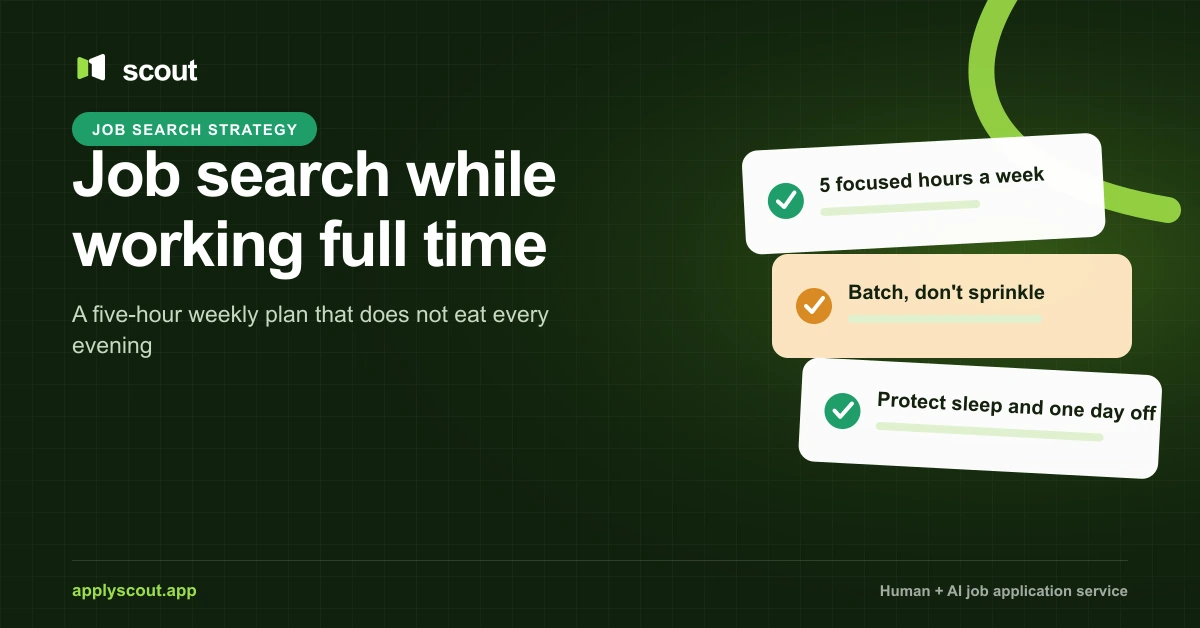
You can run a serious job search while working full time on about five focused hours a week, as long as you treat it like a small project with a fixed budget instead of an open-ended evening chore. Batch the repetitive work into two or three blocks, keep your judgment for targeting and interviews, and hand off or automate the form-filling. Protect sleep and one full day off, because a search usually runs for months, not weeks.
That last point matters more than any productivity trick. Most people who stall out do not lack discipline. They spend every evening on applications for three weeks, get exhausted, and stop.
Start with an honest time budget
Look at what a normal workday already takes. In the 2025 American Time Use Survey, full-time employed people worked an average of 8.1 hours on the days they worked, and adults averaged 5.2 hours of leisure a day, about half of it watching TV. Add commuting, cooking, family and errands, and the realistic window for a job search is small.
So pick a number and defend it. For most employed professionals, these ranges work:
| Weekly budget | Who it fits | What it buys you |
|---|---|---|
| 3 hours | Caregivers, heavy travel weeks | A handful of well-targeted applications and follow-ups |
| 5 hours | Most full-time professionals | Steady applications, networking, light interview prep |
| 8 to 10 hours | Active interview loops, urgent moves | Several interview stages plus continued pipeline |
Plan for the long haul. In SHRM’s 2025 recruiting benchmarking, median time-to-fill, from requisition to offer acceptance, was roughly a month and a half for both executive and nonexecutive roles. That is per role, from the employer’s side. Your own search, across many applications, will usually run longer. A pace you can hold for four to six months beats a sprint you abandon in week three.
How long applications actually take
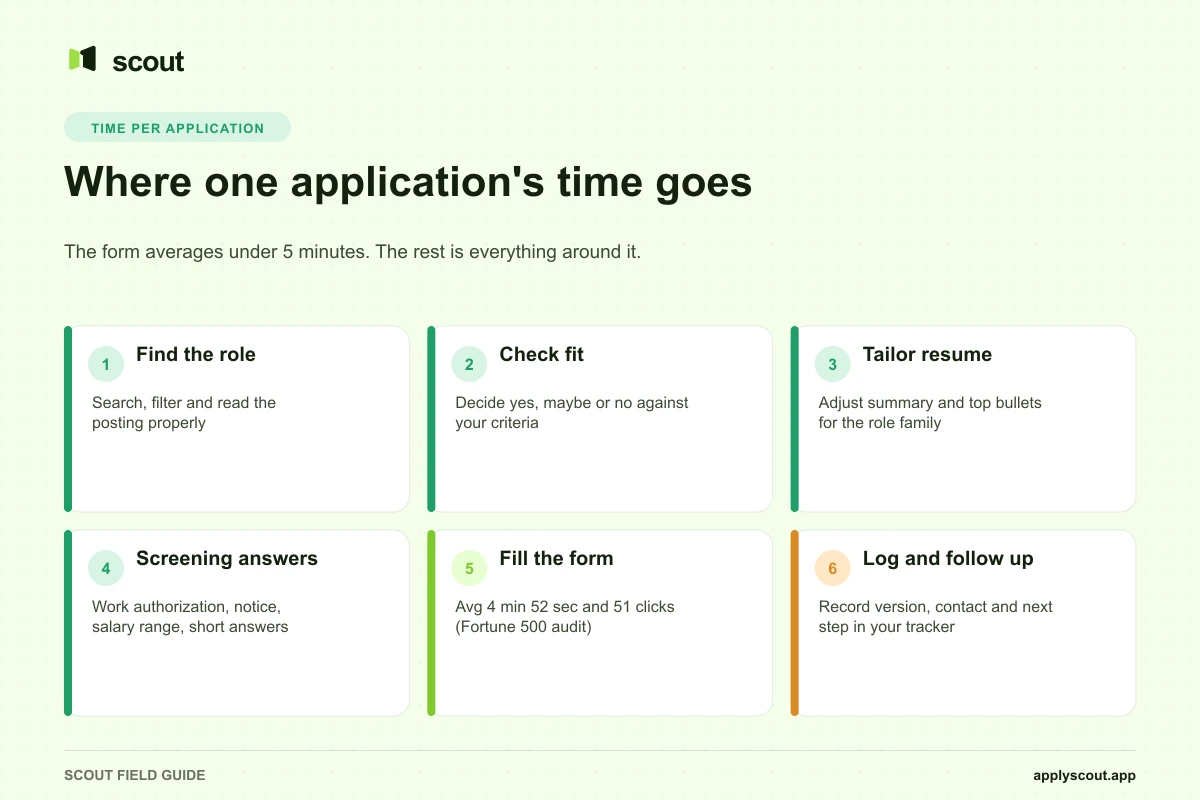
The form itself is rarely the slow part. An audit of Fortune 500 application flows by InFlight and Appcast, reported by SHRM in 2022, found the average application took 4 minutes and 52 seconds and about 51 clicks. The same report found 92% of people who clicked Apply never finished.
What eats your evening is everything around the form: finding the role, reading it properly, deciding whether you fit, adjusting your resume, answering screening questions, and logging it. In practice, a tailored application often takes 20 to 45 minutes when you do it well. That is a working estimate, not a study, and it is why five applications can quietly swallow a whole night.
A word on the famous “recruiters look at your resume for 6 seconds” line. It comes from Ladders’ eye-tracking research. Their 2018 update put the average initial screen at 7.4 seconds, up from about six in 2012. It is a single company’s small study of an initial skim, not a rule about how hiring decisions get made. The useful takeaway is narrow: make your title, recent roles and strongest results easy to find at the top.
Batch the work instead of sprinkling it
Context switching is what makes evening applications feel so draining. You open a posting, then hunt for your resume, then rewrite a summary, then dig up a reference’s email. Split the work by type and do each type in one sitting.
- Sourcing batch. Collect 10 to 20 roles into a single list. Do not apply yet. Just decide yes, maybe or no against your criteria.
- Tailoring batch. For the yes list, adjust your resume summary and top bullets per role family, not per posting. Most people need two or three resume versions, not twenty.
- Submission batch. Fill forms in one sitting with a saved answer sheet open: work authorization, notice period, salary range, links, and short answers you reuse.
- Follow-up batch. Fifteen minutes a week to log status, nudge contacts, and close dead ends.
Keep a simple tracker with columns for company, role, date applied, resume version, contact, and next step. If you are going high volume, read how to apply to hundreds of jobs without losing quality first, and check application volume vs. interview rate so you know which number to watch.
What to keep, automate, or delegate
Not every task deserves your best hour of the day. Sort them by how much judgment they need.
Keep for yourself:
- Deciding what you actually want: role, level, salary floor, location, deal-breakers.
- Networking messages and referral asks. These work because they come from you.
- Interviews, interview prep, and negotiation.
- Any answer that is sensitive or legally meaningful, like salary history where asked, disability or veteran status, and anything you are not sure about.
Automate or template:
- Job alerts on two or three boards with tight filters.
- A saved answer sheet for repeat questions.
- Calendar holds for your weekly blocks.
Delegate if the budget allows:
- Finding and shortlisting roles against your written criteria.
- Adapting your resume to each posting using only your real experience.
- Filling and submitting application forms.
- Keeping the tracker current.
If you delegate, set rules first. Nobody should add jobs, skills, or results you do not have, and you should be able to see what was sent. Our guides on what proof a job application assistant should provide and whether a service can change your resume without permission cover the checks. Be careful with browser bots that run on your own accounts, too. LinkedIn’s help center says it does not allow third-party software or extensions that automate activity on its site.
A sample 5-hour weekly plan
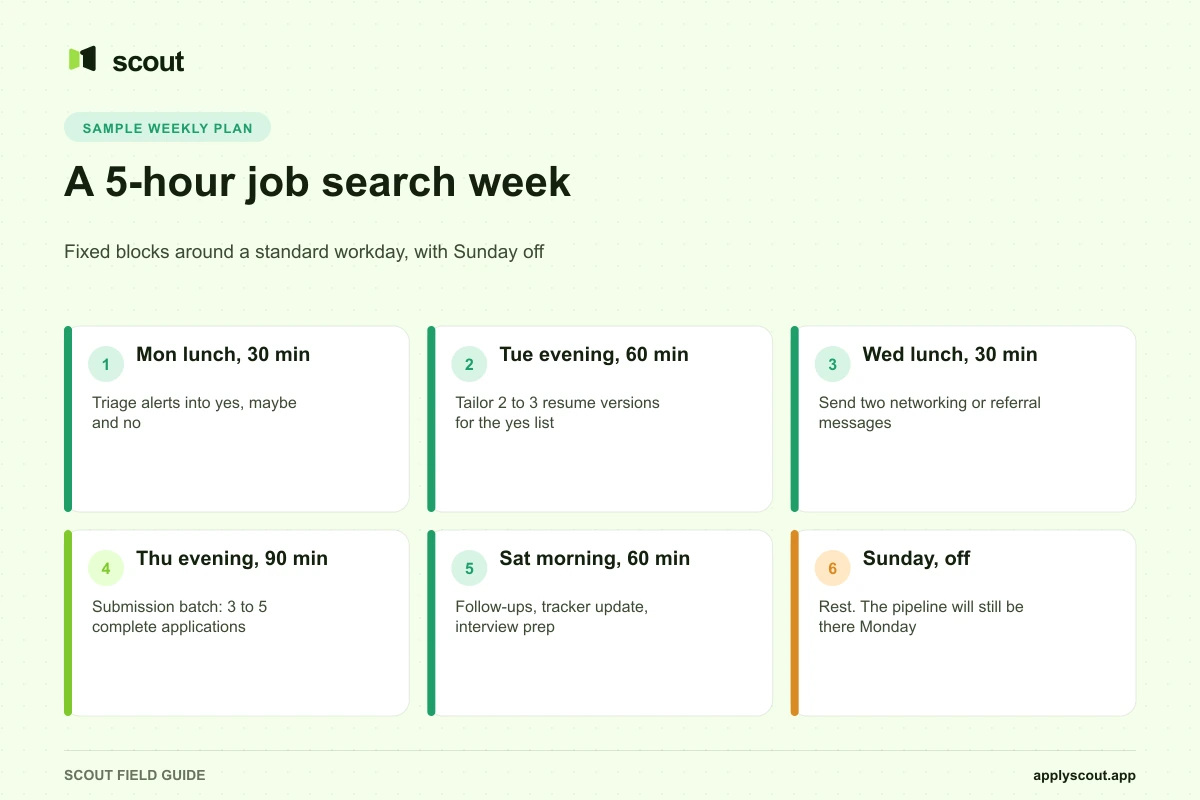
Here is a plan that fits around a standard 9-to-5. Move the blocks to match your energy, not this exact calendar.
| When | Block | Time | Output |
|---|---|---|---|
| Monday, lunch | Review alerts, sort roles into yes/maybe/no | 30 min | 10 to 15 roles triaged |
| Tuesday, 7:30 to 8:30 pm | Tailor resume versions for the yes list | 60 min | 2 to 3 updated versions |
| Wednesday, lunch | Two networking or referral messages | 30 min | 2 conversations started |
| Thursday, 7:30 to 9:00 pm | Submission batch | 90 min | 3 to 5 complete applications |
| Saturday morning | Follow-ups, tracker update, prep for any interviews | 60 min | Clean pipeline, next week planned |
| Sunday | Off | 0 | Rest |
That is 4.5 hours, with 30 minutes of slack for the week something runs over. When interviews start, cut sourcing first. Keep networking and follow-ups, because those are what turn applications into conversations.
Scheduling interviews around your job
This is where most employed searchers feel exposed. A few norms help.
Use your own time and your own tools. Take calls on a personal phone, from home, on breaks, before work, or at the end of the day. Do not use your work laptop or work email for any of it. Our guide to job searching without your employer finding out goes deeper on privacy.
Know your leave options. In the US, the Fair Labor Standards Act does not require paid vacation; it is a matter of agreement between you and your employer. Most private-sector workers do get some. In March 2026, 80% of private industry workers had access to paid vacation and 51% to paid personal leave, according to BLS. Check your handbook. A half day of PTO for a final round is normal and needs no explanation beyond “personal appointment.”
Be honest without oversharing. You do not owe your manager a reason for taking approved time off. You should not invent a fake emergency, though. “I have a personal appointment” is true and enough.
Cluster interviews. Ask recruiters for early-morning, lunch, or late-afternoon slots, and try to stack later rounds on the same day so one PTO day covers several conversations.
Scripts you can copy
Asking for a time outside work hours:
Thanks for reaching out. I’m currently employed, so early mornings or late afternoons work best for me. Could we do 8:00 am or 5:30 pm on Tuesday or Thursday? If neither works, I can make a lunch slot work with a little notice.
Requesting a video call instead of on-site for an early round:
I’d love to continue the conversation. Since I’m working full time, would a video call be possible for this round? I’m happy to come on-site for later stages.
Asking to batch a final round:
I’ll take a personal day for the final round. Would it be possible to schedule the remaining interviews back to back on one day? That would let me give each conversation my full attention.
Rescheduling because work ran over:
I’m sorry for the short notice. A work commitment has come up that I can’t move. Could we find another time this week? I’m free Wednesday before 9:00 am or after 5:00 pm.
Recruiters hear these every day. Being employed is not a mark against you, and clear availability makes their job easier.
Manage energy, not just hours
The World Health Organization describes burn-out in ICD-11 as a syndrome from chronic workplace stress that has not been successfully managed, marked by exhaustion, mental distance from the job, and reduced efficacy. If your current job is already pushing you toward that, a search that consumes every evening will make it worse.
A few rules worth holding to:
- Protect sleep. The CDC recommends seven or more hours for adults 18 to 60. Late-night applications are rarely your best work anyway.
- Stop at a fixed time. Pick a hard stop, like 9:30 pm, and close the laptop even mid-batch.
- Take one full day off. The pipeline will still be there Monday.
- Do the hard thinking when you are fresh. If you are a morning person, tailor before work and save mindless form work for evenings.
- Keep doing your current job well. It is your reference, your leverage in negotiation, and your safety net if the search takes longer than planned.
It also helps to remember why you are doing this. In Gallup’s February 2025 report, 51% of US employees were watching for or actively seeking a new job, and work-life balance and wellbeing was the most-cited “very important” factor in taking a new one, at 59%. A 2022 Pew survey of people who quit in 2021 found 63% cited low pay and 63% cited no opportunities for advancement. Write your top two reasons on your tracker. It makes the Tuesday evening block easier to start.
When to get help with the application work
If the five hours keep becoming fifteen, the bottleneck is usually the repetitive part: finding roles, tailoring and filling forms. That is the work you can hand off without giving up control of your search. For the tradeoffs, see paying someone to apply for jobs for you and human vs. AI job application services.
Scout’s Human Assistant gives you a dedicated person who finds roles that match your preferences, tailors your resume using your real experience (never invented jobs, skills, projects, or results), and applies for you. You talk in a private WhatsApp group, and your dashboard shows each job, the resume used, and screenshots of important form answers. Plans are monthly, starting at $299 for Focused Search with 250 applications a month, and you can cancel anytime. There is no placement fee and no percentage of salary. If you want a lower-cost automated option, the AI Assistant starts at $39 a month. Neither can guarantee interviews, because employers make those decisions.
That leaves your five hours for the parts only you can do: networking, interviews, and deciding which offer is worth leaving for. See the pricing page or book a free 15-minute call if you want to talk it through.
FAQ
How many hours a week should I spend job searching while employed?
Five focused hours is a sustainable default for most full-time professionals. Drop to three in heavy weeks and rise to eight to ten when you are in active interview loops.
How many applications should I send per week?
With a 5-hour budget and no help, three to eight well-targeted applications is realistic, alongside networking. Quality and fit matter more than raw count.
Can I interview during work hours?
Yes, if you use your own break time or approved leave. Use personal devices, avoid company resources, and ask recruiters for early, lunch, or late slots.
Do I have to tell my employer why I’m taking time off?
Usually not, beyond whatever your leave policy requires. “Personal appointment” is honest and normal. Do not invent a false reason.
How long does a job search take when you’re working?
Expect several months. SHRM data puts median time-to-fill for a single role at roughly a month and a half, and most searches involve many roles at different stages.
Is it better to quit first and then search?
For most people, no. Staying employed keeps your income, reduces pressure to accept a bad fit, and gives you a stronger negotiating position.
Pick your weekly number today, block it in your calendar, and let the system do the remembering for you.