Does It Matter What Time of Day You Apply for Jobs?
By Scout Editorial Team · Published September 22, 2026
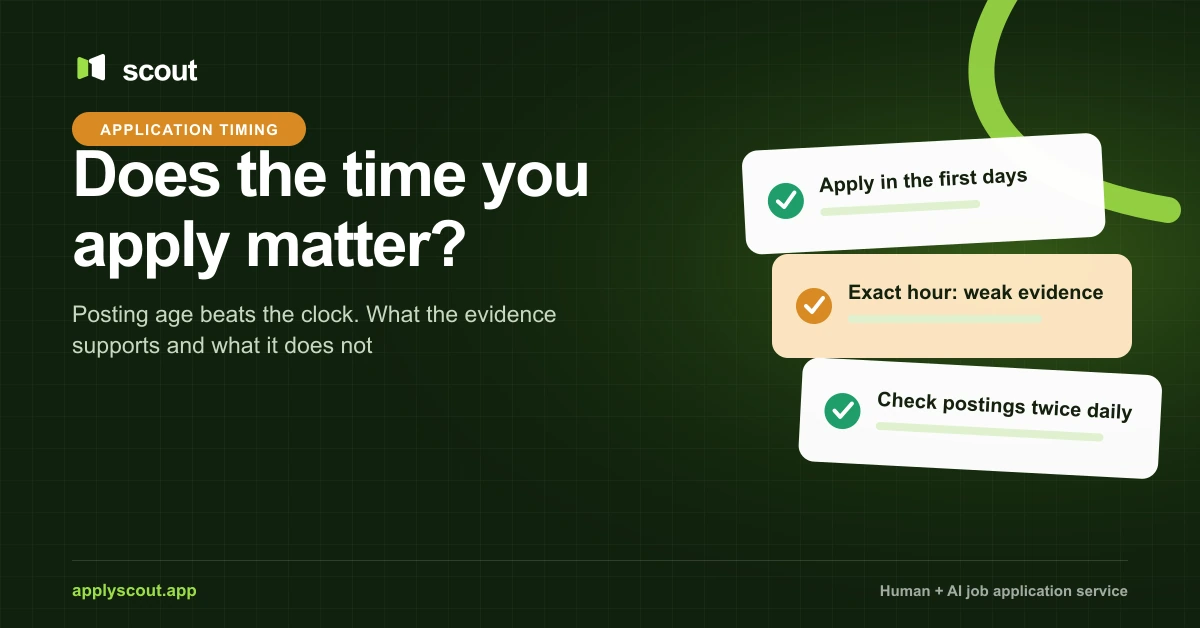
The best time to apply for jobs is early in the posting’s life, ideally within the first few days, because most applications arrive in week one and recruiters start screening quickly. The exact hour or weekday matters far less, and the evidence for “apply at 8 a.m. on a Monday” is thin and mostly traces back to one small, old dataset. Build a routine that catches new postings fast, and stop worrying about the clock.
It is easy to set an alarm to submit at 6:30 a.m. and still ignore a role that has been open for three weeks. That is the wrong priority. Here is what the data supports, what it does not, and a routine you can keep.
Where the “best time of day” advice comes from
Almost every article claiming a best hour or day traces to TalentWorks, a startup that published job-search analyses around 2017 and 2018. Its website now redirects to a parked page, but archived copies survive.
In a January 2018 post, TalentWorks said it analyzed 4,000+ job applications and reported that applying between 6 a.m. and 10 a.m. gave an 89.1% boost, applying on Mondays a 46.0% boost, and applying in the first four days a 64.7% boost. The same post claimed the morning window could be worth up to 5x for a single application.
Before you build your week around that, consider what the study was:
- Small and unrepresentative. A few thousand applications from one company’s users, not a random sample of job seekers or employers.
- Not peer reviewed. The full method, controls, and confidence intervals were never published.
- Commercially motivated. The post itself promoted a product that automatically chose when to apply on users’ behalf.
- Old. The data predates remote hiring at scale, AI resume screening, and the jump in applicant volume since 2021.
- Correlational. People who apply at 7 a.m. on a Monday may differ from people who apply at 11 p.m. on a Friday in ways that matter more than the clock.
None of this means the findings are false. It means they are weak evidence, recycled for years by sites that rarely link the original. When you see “you’re 5x more likely to get an interview if you apply before 10 a.m.,” that is usually where it comes from.
The stronger claim: apply early in the posting’s life
The evidence for applying early in a posting’s lifetime is better, because it lines up with how hiring teams work and with large-scale applicant tracking data.
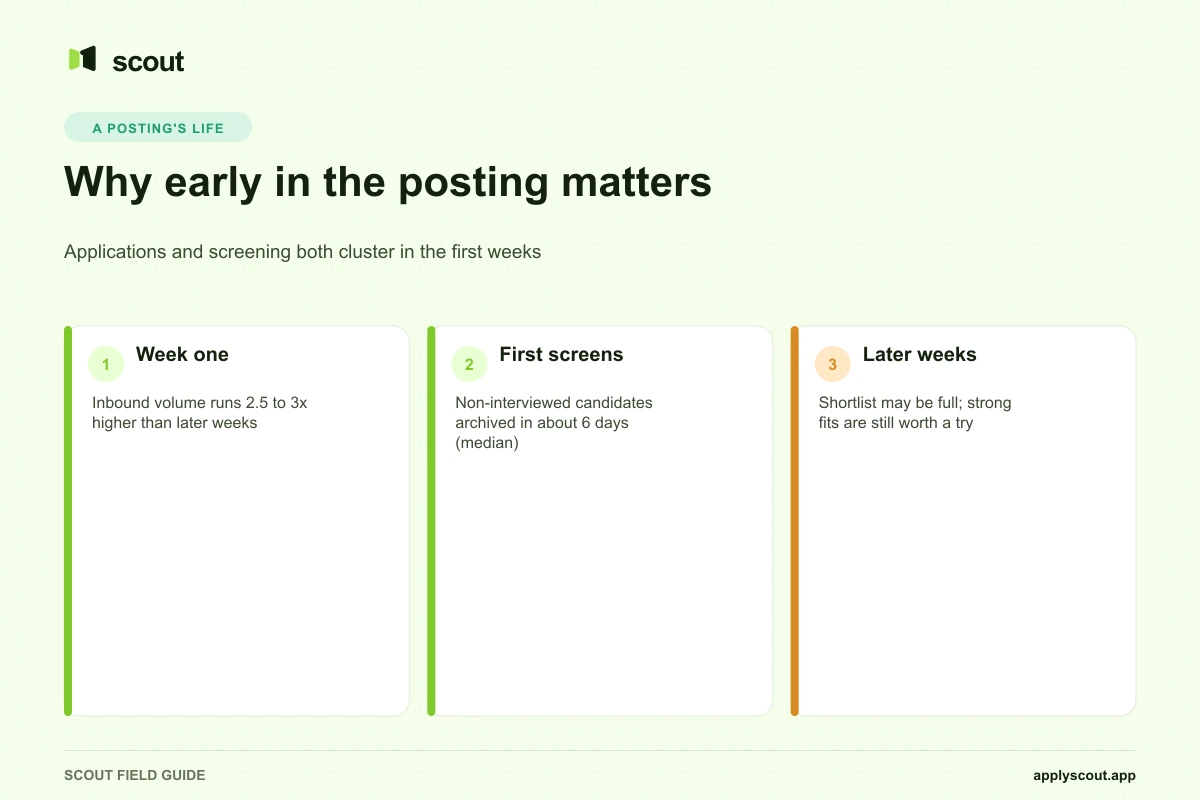
Applications pile up in week one. Ashby, an applicant tracking system, analyzed roughly 13 million to 14 million applications from 2021 to 2023 and found that the first week of inbound applications is consistently 2.5 to 3 times higher than all following weeks. The posting sits at the top of job boards and draws the most traffic early.
Recruiters decide fast. Ashby’s recruiting operations benchmarks, covering 54 million applications from 2021 through March 2026, report that candidates who were not interviewed were archived after a median of about 6 days. Rejections, in other words, often happen within a week. If a shortlist forms in the first week or two, a strong application arriving in week four is competing for whatever slots remain.
Volume is high. Greenhouse reports 244 applications per job in 2025, more than double the 2022 figure. Ashby says roles now receive more than 300 applications per hire on average. In piles that size, being reviewed before the shortlist is full is a real advantage.
TalentWorks also published a timing study on this point. Using a sample of 1,600 applications, it reported that applying in the first 96 hours made candidates up to 8x more likely to get an interview, with odds dropping about 28% for each day of delay after that. The same caveats apply, and I would not trust the exact multipliers. The direction, though, agrees with the Ashby volume data and with how recruiters describe their workflow.
Indeed’s own career guidance is more modest: most job postings stay active for 30 days, and it suggests applying within a week or two of posting. It also notes that some employers state they review applications on a rolling basis.
Claims you will see, rated
| Claim | Evidence strength | What supports it |
|---|---|---|
| Apply within the first few days of posting | Moderate to strong | ATS data showing first-week application spikes; fast screening and archiving; practitioner consensus |
| Applying after two to three weeks hurts your odds | Moderate | Same mechanism; varies by role and employer |
| Apply between 6 a.m. and 10 a.m. | Weak | One small 2018 company analysis; no independent replication found |
| Apply on Monday, avoid Friday | Weak | Same 2018 analysis; no independent replication found |
| ”Apply in the first 10 minutes to be 4x more likely to hear back” | Untraced | Widely repeated and attributed to LinkedIn, but we could not find a primary LinkedIn source |
| ”Most interviews go to people who apply in the first 24 hours” | Untraced | Repeated on blogs and newsletters without a verifiable dataset |
| Senior roles stay open longer, so timing matters less | Moderate | Longer time to fill for senior roles in ATS benchmarks |
That last row is worth expanding. Ashby reports a median of 71 days to fill senior roles versus 52 for junior roles, and Greenhouse’s overall time to fill was 59.67 days in 2025. A senior search often has a longer, more deliberate review. Early still helps, but a well-tailored application on day 8 can beat a rushed one on day 1.
Why the hour probably matters little
Think about what happens after you click submit. Your application lands in an applicant tracking system queue. A recruiter opens that queue when their calendar allows, often sorted or filtered by criteria they choose. Few recruiters read applications the minute they arrive.
So a 7 a.m. application and an 8 p.m. application submitted the same day will usually be reviewed in the same session. What separates them is whether either arrives before the recruiter’s first pass, and that is about the day, not the hour.
There is one partial exception. If a posting is getting hundreds of applicants a day and the recruiter screens in order, then hours can matter in the first 24 to 48 hours. That situation is real for popular roles at well-known companies, but you cannot see it from the outside, and it argues for checking new postings often, not for submitting at a particular time.
LinkedIn shows applicant counts on many postings, but read them cautiously. Its help page notes that for jobs that redirect to an external site, the count may reflect clicks rather than completed applications. A “200 applicants” label on day two does not mean the role is closed to you.
A practical daily routine
You do not need to sit on job boards all day. You need a system that surfaces new postings while they are fresh and a short daily window to act on them.
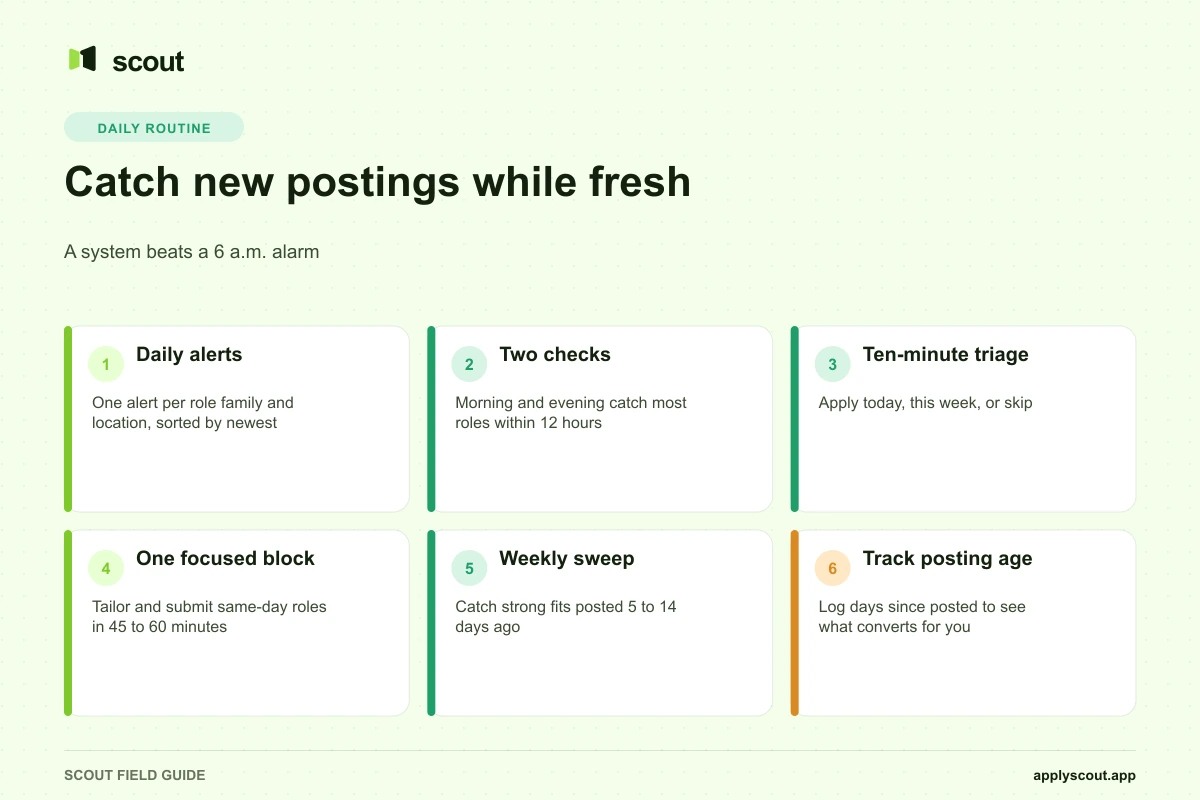
1. Set precise alerts. On LinkedIn, alerts can be set to daily or weekly delivery by email, app notification, or both. Choose daily. Build separate alerts for each role family and location rather than one broad search, and sort by most recent. Add alerts on the careers pages or applicant tracking job boards of your top 20 target companies, since some roles appear there before they reach aggregators.
2. Check twice a day. A morning check (before work) and an evening check catches nearly everything within 12 hours of posting. Anything more frequent has rapidly diminishing returns for most people.
3. Triage in under ten minutes. Sort new postings into apply today, apply this week, and skip. “Apply today” is for strong fits posted in the last 48 hours.
4. Submit in one focused block. Tailor and submit the “apply today” roles in a single 45 to 60 minute block. If you apply in the evening, that is fine. The posting age matters more than the clock.
5. Do a weekly sweep. Once a week, look for good roles posted 5 to 14 days ago that you missed. They are still worth applying to if the fit is strong, especially at senior levels.
6. Track posting age. Add a “days since posted when applied” column to your tracker. After a month you will see whether early applications convert better for your search, which beats any general statistic. The guide to application volume and interview rate shows how to read that data without fooling yourself.
As you speed up, duplicates become a risk: the same role reposted on three boards with three dates. Use the requisition ID to check before you submit. The duplicate application guide explains how.
Time zones and remote roles
For remote roles, the posting’s time zone tells you when the recruiter’s workday starts. If you are on the US West Coast applying to a New York company, a role posted at 9 a.m. Eastern has been live for three hours when you wake up. Your morning check covers it.
If you are applying across larger gaps, such as Europe to the US West Coast, your evening check is the one that matters, since that is when new US postings appear. Do not set a 3 a.m. alarm. A same-day application is early enough for almost every role.
Two other remote-specific points. Read the location requirement carefully, because “remote” often means remote within one country or a set of states. And check the posting’s time zone overlap requirements, since a mismatch there will get you screened out regardless of when you applied.
How long postings stay open
Postings commonly stay live about 30 days, according to Indeed’s guidance, but a live posting is not proof of an active search. Some employers leave postings up after building a shortlist; others repost an old role to refresh its position on job boards.
A few signals help:
- “Reposted” labels on boards usually mean the role is still open but lacked candidates the first time. These are worth applying to.
- Very old postings (more than 45 days) at companies with no other recent activity deserve lower priority.
- Rolling review language in the posting tells you early really does matter for that role.
Where Scout fits
The hard part of applying early is not knowing the rule. It is checking postings every day while you have a job. Scout’s Human Assistant gives you a dedicated human assistant who finds roles matching your preferences and checks new postings in batches through the day, then tailors your resume using your real experience (never inventing anything) and applies for you. You coordinate in a WhatsApp group, and a dashboard shows each job, the resume used, and screenshots of important answers.
Plans are monthly from $299 for Focused Search (250 applications per month), cancel anytime, no placement fee or salary percentage. Applying early improves your position in the queue; it does not guarantee interviews, and neither does Scout. The AI Assistant starts at $39 per month. See how it works or compare plans on the pricing page. If you are weighing automation, does AI applying to jobs work covers the tradeoffs.
FAQ
Is it better to apply in the morning or at night?
There is no reliable evidence that the hour matters much. The commonly cited morning advantage comes from one small 2018 analysis. Apply the same day you see a strong posting, whatever the time.
Is Monday the best day to apply for jobs?
The Monday claim also traces to that 2018 analysis and has not been independently confirmed. A posting’s age matters more than the weekday you apply.
Is it too late to apply to a job posted two weeks ago?
Not necessarily. If the posting is still live and you are a strong fit, apply. Your odds are likely lower than in week one, but senior and specialized roles often take months to fill.
Should I apply on weekends?
Yes, if that is when you have time. Your application will usually be reviewed on Monday alongside others, which is no worse than applying Monday morning.
How often should I check for new job postings?
Twice a day is enough for most searches: once in the morning and once in the evening. Set daily alerts so new postings come to you.
Does being one of the first applicants guarantee an interview?
No. Early applications get reviewed while the shortlist is still open, but fit, resume evidence, and the employer’s needs still decide the outcome.
Catch postings early, apply on the same day, and spend the energy you save on tailoring. If you want help keeping up with new postings, you can book a call.