Does AI Applying to Jobs Work? What to Measure
By Scout Editorial Team · Published June 16, 2026 · Updated August 21, 2026
AI applying to jobs can work as an operations tool: it can reduce form-filling, prepare job-specific drafts, enforce search rules, and maintain records. It cannot make an unqualified candidate qualified or guarantee interviews. Whether it helps should be measured by interview rate, application accuracy, and time saved—not by the number of forms submitted.
The useful question is not “Did AI apply?” It is “Did the system send truthful applications to suitable roles, and did that produce better results than the candidate’s previous process?”
What AI is good at
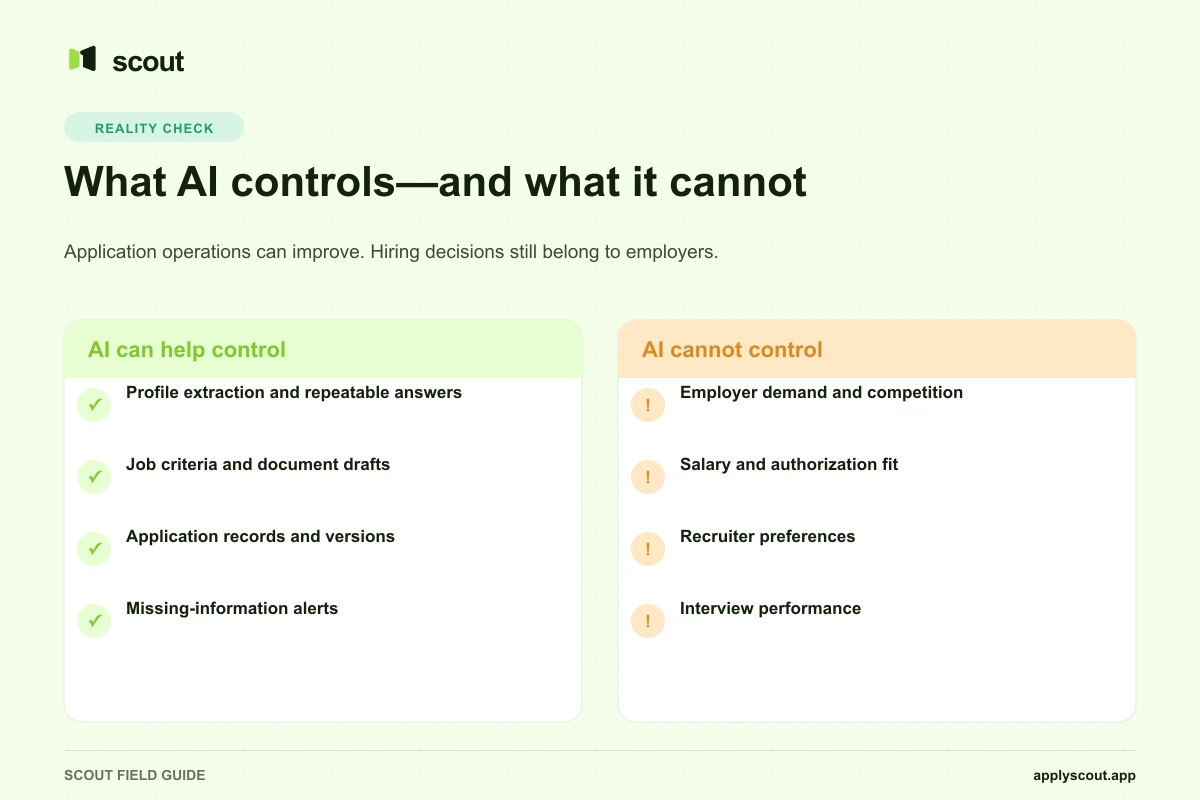
AI can perform repeatable parts of an application workflow:
- Extract structured work history from a resume.
- Compare a job description with stated skills and preferences.
- Draft a role-specific summary or cover note.
- Reorder truthful resume content for relevance.
- Reuse approved answers to repeated questions.
- Flag missing or conflicting information.
- Record the job, date, status, and document version.
These tasks save time because they are repetitive. They still need rules, quality checks, and escalation paths.
What AI cannot solve
AI does not control:
- Employer demand or hiring freezes.
- Competition for the role.
- Whether your salary range fits the budget.
- Work-authorization constraints.
- The strength of your actual experience.
- Recruiter preferences.
- Interview performance.
- Whether a job posting is still active or already close to filled.
Any service promising that AI alone will get a job is overstating what the technology controls.
Four failure modes
1. Weak targeting
High application volume can hide poor matching. If the system applies to adjacent titles, wrong seniority levels, unsuitable locations, or jobs requiring unavailable sponsorship, the total count rises while the useful pipeline does not.
The fix is a job profile with hard filters, exclusions, and an approval or exception workflow. Use the step-by-step guide to stop auto-apply tools from choosing wrong jobs.
2. Fabricated tailoring
Tailoring should change emphasis, not facts. An AI system may be tempted to fill a perceived gap with an unsupported skill or exaggerated result. Every application process needs an immutable source resume and a rule against adding unverified experience.
3. Unreviewed sensitive answers
Salary, sponsorship, clearance, criminal history, disability, and demographic questions should not be inferred. They require approved answers or candidate review.
4. Platform-policy violations
Some platforms prohibit third-party automated activity. LinkedIn’s published guidance says third-party software that automates activity on its website is not permitted, and Indeed tells job seekers not to use third-party bots to apply. Automation therefore is not universally “safe” merely because it is slow or personalized.
How to test whether AI applying works for you
Run a controlled four-week test instead of judging by application count.
Establish a baseline
Review your previous 30–50 applications:
- How many met your real criteria?
- How many produced recruiter screens?
- How long did each application take?
- How many duplicate or incorrect submissions occurred?
Define one focused profile
Use one role family, a realistic seniority band, allowed locations, salary requirements, work-authorization rules, and excluded employers. Mixing unrelated searches makes the results hard to interpret.
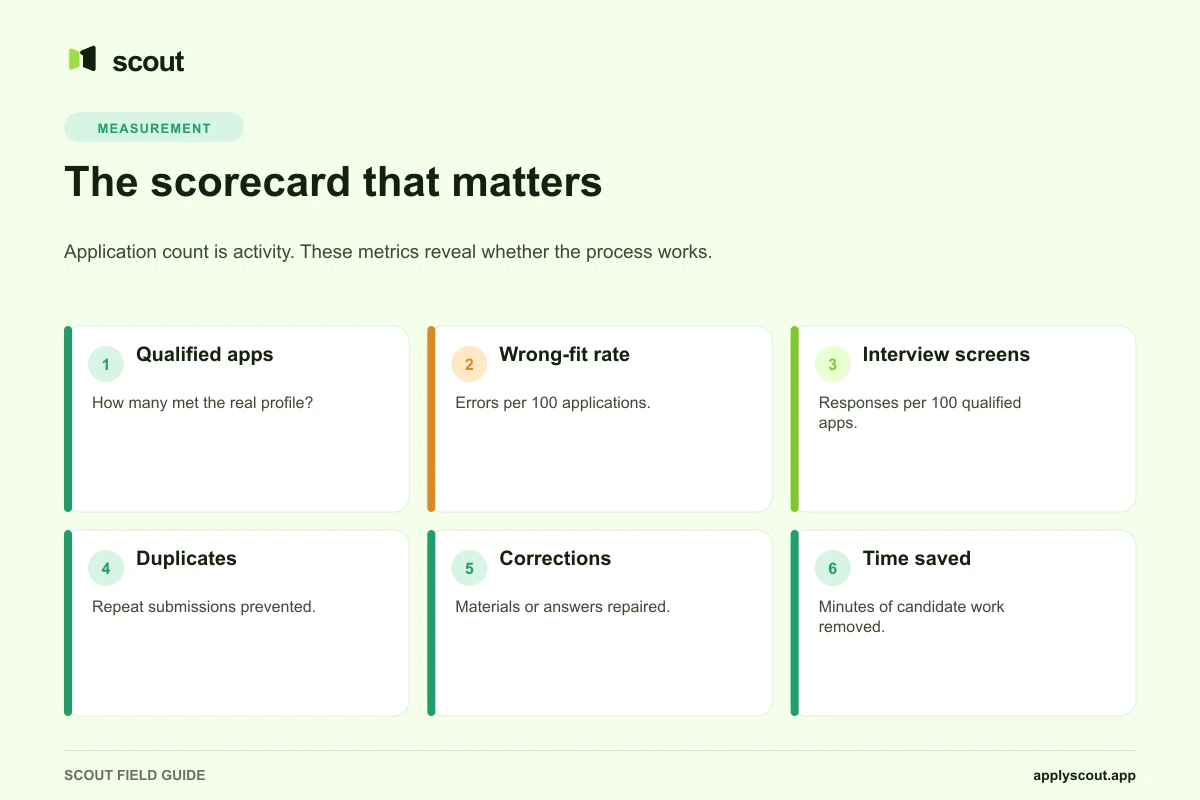
Track quality metrics
Measure:
| Metric | Why it matters |
|---|---|
| Qualified applications | Shows whether matching rules work |
| Wrong-fit applications per 100 | Exposes quality failures hidden by volume |
| Interview screens per 100 | Measures useful outcomes |
| Duplicate applications | Tests record keeping |
| Corrections required | Tests profile and drafting accuracy |
| Minutes of candidate work per application | Measures actual time saved |
Do not compare a week of automated applications with a year of manual searching. Use a comparable role, market, and time period.
Human review versus AI-only execution
AI-only service is appropriate when the search is narrow and the answers are predictable. Human review becomes more valuable for career changes, executive roles, multiple role families, complex work authorization, and unusual screening questions. The Human vs AI application-service guide turns those differences into a buyer checklist.
Scout separates these needs:
- The AI Assistant is a lower-cost workflow built around guided profile import, job profiles, tailored materials, and tracking.
- The Human Assistant adds a dedicated person, WhatsApp communication, and detailed evidence for important application answers.
Neither lane changes the underlying requirement: applications must remain truthful and aligned with the candidate’s rules.
Does applying earlier help?
A fresh listing may be worth prioritizing because employers can review candidates before the advertised closing date. But there is no universal rule that the first applicant wins, and speed should not override fit or accuracy.
Use posting age as one ranking signal—not as permission to send a rushed or unsuitable application.
Bottom line
AI applying works when it improves the process you can measure: less repetitive work, better record keeping, consistent job criteria, accurate materials, and a higher-quality interview pipeline. It fails when it turns application count into the goal.
Start with a focused profile, review the outputs, and measure interviews per 100 qualified applications. That is a more useful answer than any promise about how many jobs an AI can apply to overnight.
Sources and methodology
This guide was updated on August 21, 2026 against Scout’s current product model and application-quality guidance. Platform-risk statements were checked against LinkedIn’s prohibited software guidance and Indeed’s Jobseeker Guidelines. No universal interview-rate claim is made because results depend on the candidate, role, location, and market.