Can a Job Service Change Your Resume?
By Scout Editorial Team · Published August 26, 2026
A job application service should not make unrestricted resume changes without your permission. You can authorize defined tailoring—such as selecting relevant achievements, changing order, or adjusting truthful wording—but employers receive the document in your name. Preserve the original, define prohibited edits, require approval for material changes, and retain the exact version submitted to every job.
Permission should be a policy, not a vague checkbox that says “optimize my resume.”
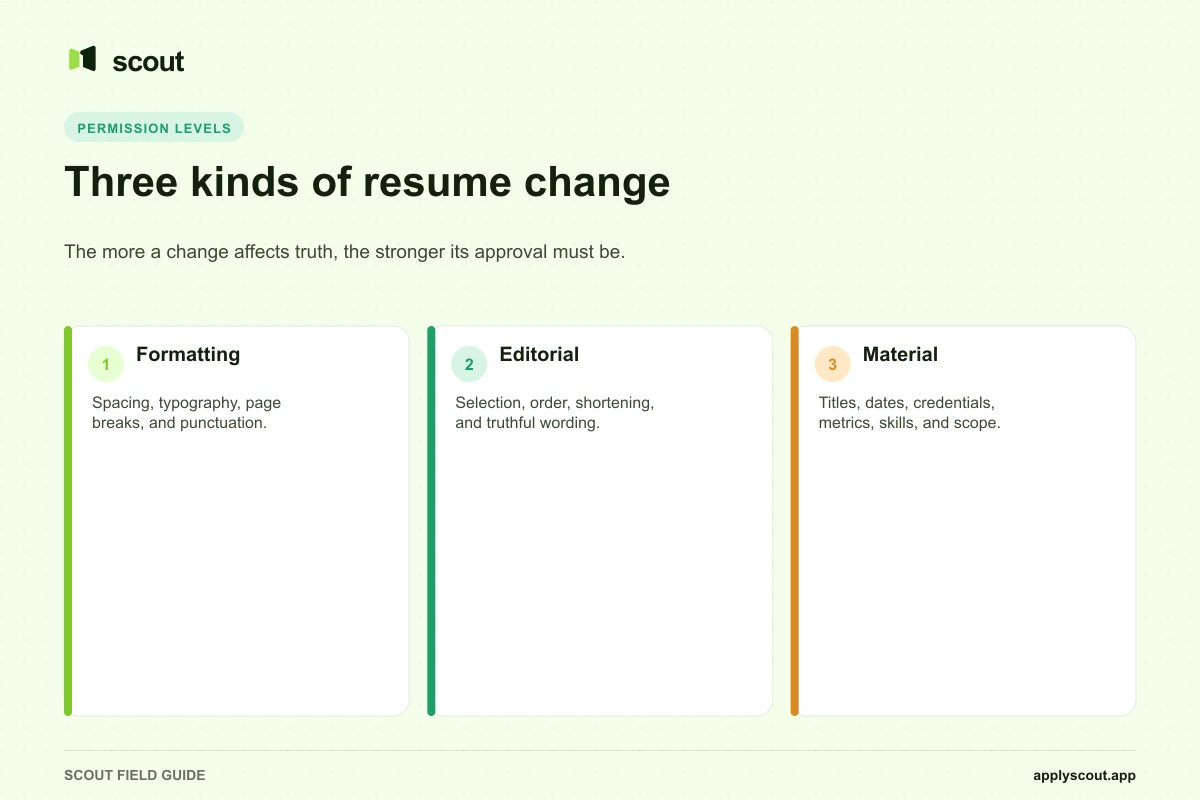
Three levels of resume editing permission
| Level | Examples | Recommended approval |
|---|---|---|
| Formatting | Spacing, page breaks, typography, consistent punctuation | Standing permission after template approval |
| Editorial tailoring | Reordering bullets, shortening unrelated content, choosing relevant source facts, truthful keyword alignment | Written rules plus sample audit |
| Material factual change | Titles, dates, employers, degrees, certifications, tools, metrics, scope, work authorization | Direct candidate approval with evidence |
The third category should never be inferred from a job description. If a posting asks for Kubernetes, that does not authorize adding Kubernetes to your skills. If it asks for management experience, “supported a team” cannot automatically become “managed a team.”
What safe tailoring can do
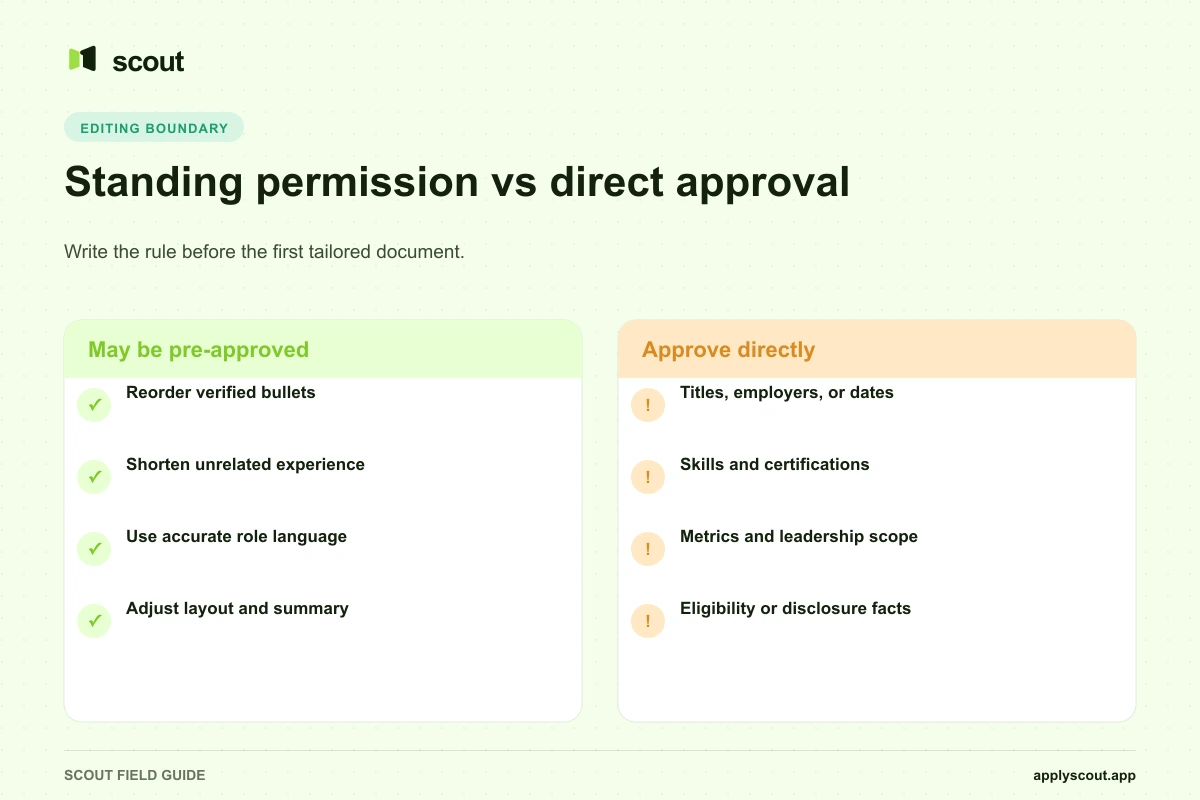
Tailoring is useful when it improves relevance without changing the underlying truth. A service may, with your permission:
- Select achievements relevant to the role.
- Reorder sections and bullets.
- Replace an accurate synonym with terminology used by the employer.
- Shorten older or unrelated experience.
- Adjust the professional summary for the target role.
- Turn verified notes into concise resume bullets.
- Produce a role-specific cover note from approved evidence.
The test is whether you could defend the wording with the same evidence in an interview or background check.
Changes that need explicit approval
Require direct approval before:
- Changing a formal job title rather than adding a clarifying equivalent.
- Altering employment or education dates.
- Adding a skill, tool, language, license, clearance, or certification.
- Introducing or strengthening a number.
- Changing individual contribution into leadership.
- Claiming ownership of a team outcome.
- Removing information that affects eligibility or required disclosure.
- Translating a resume into a language in which you cannot interview.
Some candidates use a familiar market-facing title beside the formal title—for example, Customer Adviser (Customer Success Manager equivalent). That can be reasonable when it clarifies rather than disguises the role, but approve the convention before it is repeated.
Write a resume permission policy
A useful policy answers five questions:
- Which source document and facts are authoritative?
- Which edits can happen automatically?
- Which edits require review?
- Which facts must never change?
- How will versions and approvals be recorded?
Example:
You may reorder and shorten bullets, select verified achievements, and use accurate role terminology. Do not change employer names, formal titles, dates, degrees, certifications, tools, metrics, management scope, or eligibility facts without written approval. Preserve the source resume and save the exact submitted copy.
Adjust that language to your circumstances. A regulated profession or security-cleared search may require stricter controls.
How invented claims enter a resume
Fabrication is not always dramatic. It often begins through small transformations:
- A desired qualification is mistaken for candidate experience.
- A team achievement is rewritten as an individual achievement.
- A responsibility becomes an outcome.
- “Familiar with” becomes “proficient in.”
- A percentage loses its time period or denominator.
- A role-family template is reused for the wrong person.
- A tailored copy becomes the source for the next tailored copy.
Prevent that last problem with resume version control. Every job-specific copy should trace back to a verified source or role-family master.
Audit the first tailored batch
Review the first 10–20 documents as diffs. Highlight added or changed words, then classify each change as formatting, editorial, or material.
Ask:
- Does every new claim exist in the source record?
- Did the strength of the verb change?
- Did any number change or lose context?
- Are required qualifications presented as actual experience only when true?
- Is the file readable after conversion to PDF?
- Is the correct version linked to the correct job?
If one source fact is wrong, pause. Correct it centrally and identify every application affected by the bad value.
What to do after an unauthorized change
First, stop new applications. Save the altered file and the application records; do not erase the evidence.
Then:
- Identify the rule or source that produced the change.
- Find every derivative document containing it.
- Determine which files were actually submitted.
- Correct the source and future-generation rule.
- Decide whether affected employers need a corrected document.
- Resume only after a clean test batch.
A minor style preference may need only a process correction. A false credential, date, eligibility answer, or material achievement deserves a more careful response.
What to demand from a provider
Ask whether the service:
- Preserves an immutable original.
- Shows changes before submission.
- Supports a use-original-without-tailoring option.
- Retains every submitted version.
- Records who or what made each edit.
- Lets you correct one source fact across future drafts.
- Provides application-level proof.
- Stops immediately when permission is withdrawn.
Scout records the resume associated with each application and supports separate job profiles. Compare the Human and AI service lanes and current plans before choosing how much judgment and evidence you need.
The candidate remains accountable
Delegating writing or application work does not transfer responsibility for the claims. Treat every resume as a statement made in your name. Give the service enough verified source material to tailor well, but keep a narrow permission boundary around facts.