How to Apply to Hundreds of Jobs Without Losing Quality
By Scout Editorial Team · Published June 20, 2026 · Updated August 21, 2026

To apply to hundreds of jobs responsibly, build a controlled pipeline: define narrow job profiles, filter before applying, preserve truthful materials, track every submission, and measure interviews per 100 qualified applications. Application count is capacity, not success.
If quality falls as volume rises, scaling makes the search worse. The objective is to remove repetitive work while keeping the decisions that protect your professional identity.
Start with capacity math
“Hundreds of jobs” should describe a complete campaign, not necessarily one day or week.
If one careful application takes 15 minutes, 200 applications require 50 hours. Tools or assistants can reduce that workload, but they cannot remove the need for accurate profiles, exceptions, and quality review.
Set a campaign target based on the number of genuinely suitable roles available. A narrow local executive search may not contain 500 appropriate openings. A broad remote software search might.
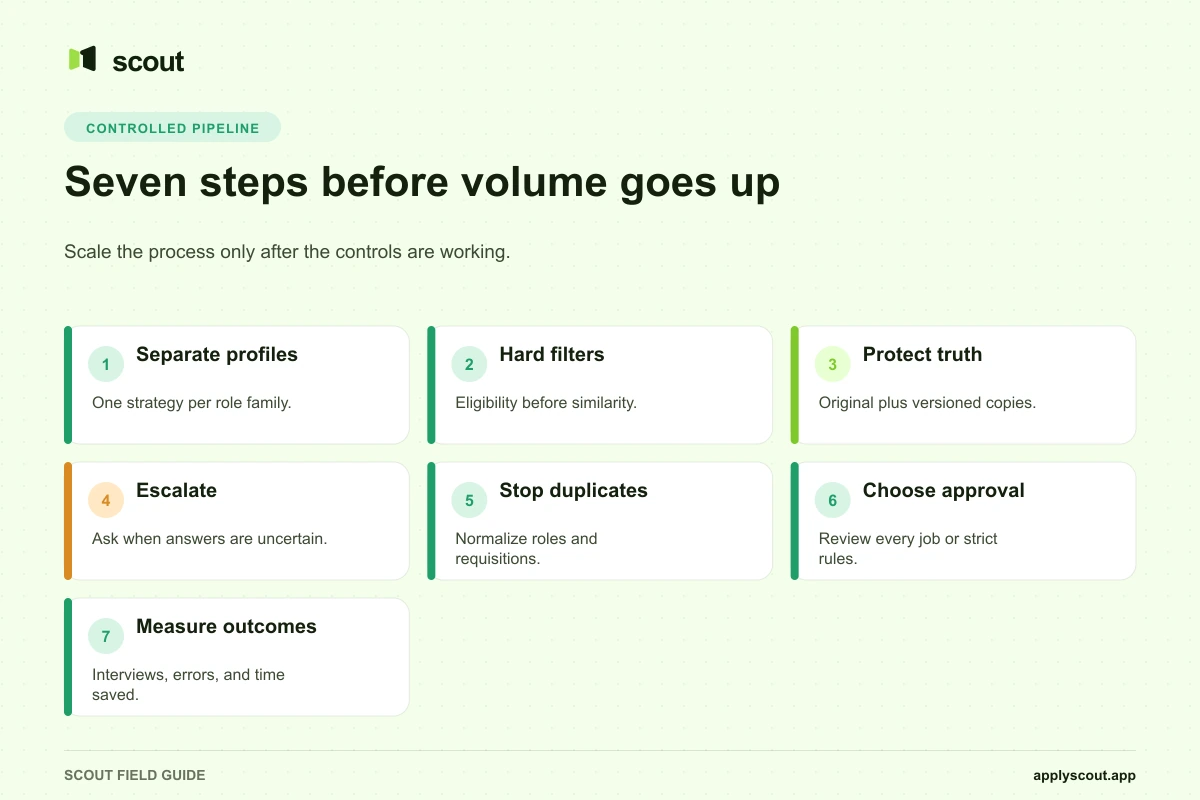
Step 1: Separate different searches
Do not use one generic profile for unrelated jobs. Create separate profiles when the target changes materially.
Each profile should specify:
- Target titles and acceptable alternatives.
- Seniority range.
- Required and excluded locations.
- Remote, hybrid, or onsite rules.
- Salary floor.
- Employment and contract type.
- Work authorization and sponsorship.
- Required certifications or clearance.
- Companies to include or block.
- Resume to use and whether tailoring is allowed.
A product-operations search and a program-management search may share experience, but the strongest evidence and acceptable titles can differ. Separate profiles make matching, documents, and results easier to evaluate.
Step 2: Use hard filters before fit scores
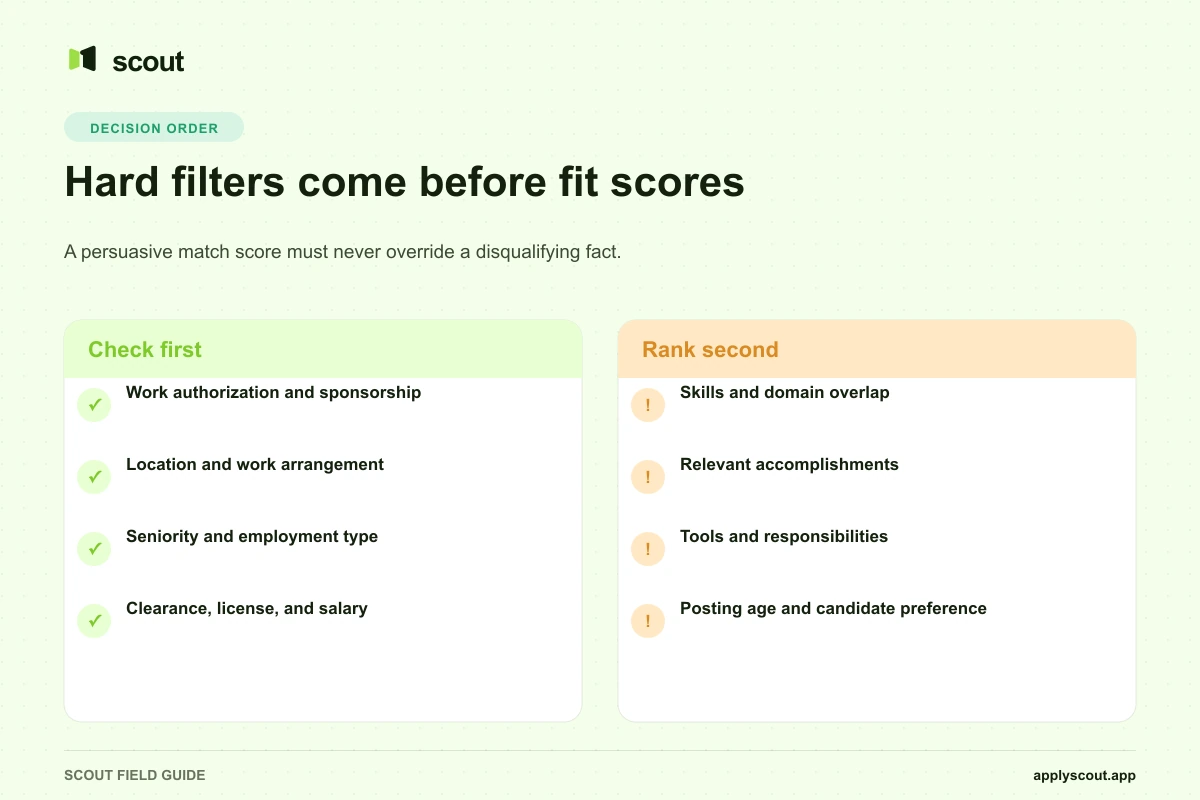
Some criteria are not negotiable. A high semantic match does not matter if the role requires clearance you do not have or onsite work in a location you cannot reach.
Apply hard filters first:
- Legal and work-authorization eligibility.
- Location and work arrangement.
- Seniority.
- Required license, certification, or clearance.
- Salary and employment type.
- Blocked employers.
Then rank the remaining jobs by skills and experience. This prevents a persuasive-looking match score from overriding a disqualifying fact.
Step 3: Protect resume truth
Scaling requires version control.
- Preserve an immutable original resume.
- Tailor only a copy.
- Never add experience that cannot be supported.
- Save the exact version attached to each application.
- Review changes to dates, titles, metrics, certifications, and tools.
- Correct profile errors once so they do not spread to future applications.
Tailoring should change emphasis and ordering. It should not convert a related skill into direct experience.
Step 4: Decide what must be escalated
Build an “ask, do not guess” list for:
- Salary expectations.
- Work authorization and sponsorship.
- Security clearance.
- Relocation.
- Criminal-history questions.
- Disability and demographic forms.
- Conflicts of interest.
- Non-compete obligations.
- Willingness to travel.
Approved reusable answers can speed up future forms. Ambiguous wording should return to you or a human assistant.
Step 5: Prevent duplicate applications
At scale, the same job may appear on a company site, LinkedIn, Indeed, and an agency feed. Titles and tracking parameters can change while the underlying requisition stays the same.
Track the employer, normalized title, location, source URL, requisition ID when available, date, resume version, and status. Duplicate detection should check more than an exact URL. The duplicate application guide explains how to normalize cross-posted and reposted jobs.
Before submitting, also consider whether you are already interviewing with the company or were referred through another channel.
Step 6: Choose approval rules
Three useful modes are:
- Approve every job: best while testing a new profile or service.
- Apply within hard rules: appropriate after you trust the matching and exception process.
- Apply only to jobs I add: useful for highly selective searches.
The mode should be visible and easy to pause. Start with more review, then relax it only when the quality data supports that decision.
Step 7: Track outcomes, not activity
Review results in comparable groups of 50 or 100 qualified applications.
| Metric | Healthy question |
|---|---|
| Qualified applications | Did these jobs actually meet the profile? |
| Wrong-fit rate | How often did the rules fail? |
| Interview screens | Which profiles and resumes produced responses? |
| Duplicate rate | Did the tracking system prevent repeat submissions? |
| Correction rate | How often did materials or answers need repair? |
| Candidate time | How much work was genuinely removed? |
If one profile produces interviews and another does not, investigate targeting and positioning before increasing the second profile’s volume.
Where Human and AI Assistants fit
Scout provides two execution lanes:
- The AI Assistant is suited to repeatable, well-defined profiles and lower-cost throughput.
- The Human Assistant adds direct WhatsApp communication, human judgment, and detailed application evidence.
Both use job profiles and application records. The difference is the level of human handling and proof. The live pricing page lists current allowances and profile limits.
Do not ignore platform rules
Applying at a human-looking pace does not automatically make third-party automation permitted. LinkedIn and Indeed publish restrictions on automated activity. Check the current rules for each source and understand whether the service is using a platform account, an employer’s career site, or a supported ATS workflow.
See Is Using a Job Application Bot Safe? before enabling automation.
Bottom line
The right way to apply to hundreds of jobs is to scale a quality-controlled process. Separate profiles, hard filters, truthful versioned resumes, exception handling, duplicate prevention, and outcome measurement must exist before the application count rises.
Use automation or assistants to remove repetition. Keep eligibility, truth, sensitive answers, and campaign direction under explicit control.
Sources and methodology
This article was updated on July 16, 2026 to match Scout’s current profile, resume, and Human/AI service model. Platform-policy cautions reference LinkedIn’s prohibited software guidance and Indeed’s Jobseeker Guidelines.