How to Tailor Your Resume to Every Job Without Lying
By Scout Editorial Team · Published September 4, 2026
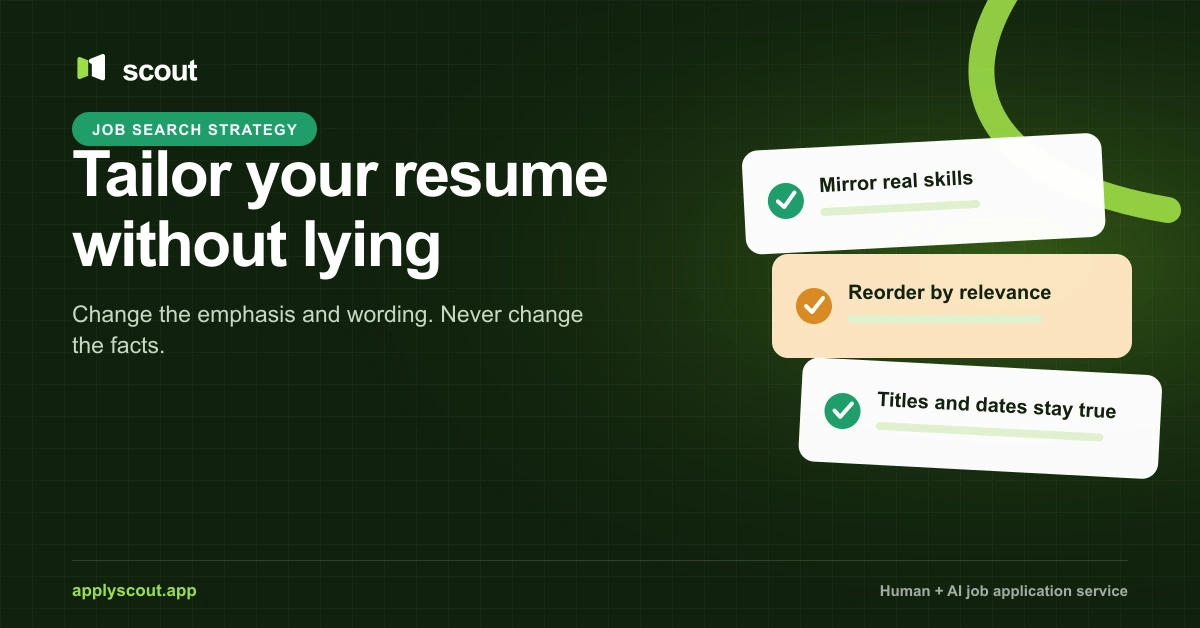
To tailor your resume to a job description without lying, change the order, emphasis, and wording of things you have actually done, and never change the facts. Mirror the employer’s terms for skills you truly have, lead with your most relevant results, and leave out what doesn’t fit. Titles, dates, degrees, employers, and skills stay exactly as true as they were yesterday.
That’s the whole rule. The rest of this guide is how to apply it quickly, why the “beat the robot” advice that pushes people toward padding is mostly wrong, and what happens when someone crosses the line.
How applicant tracking systems actually work
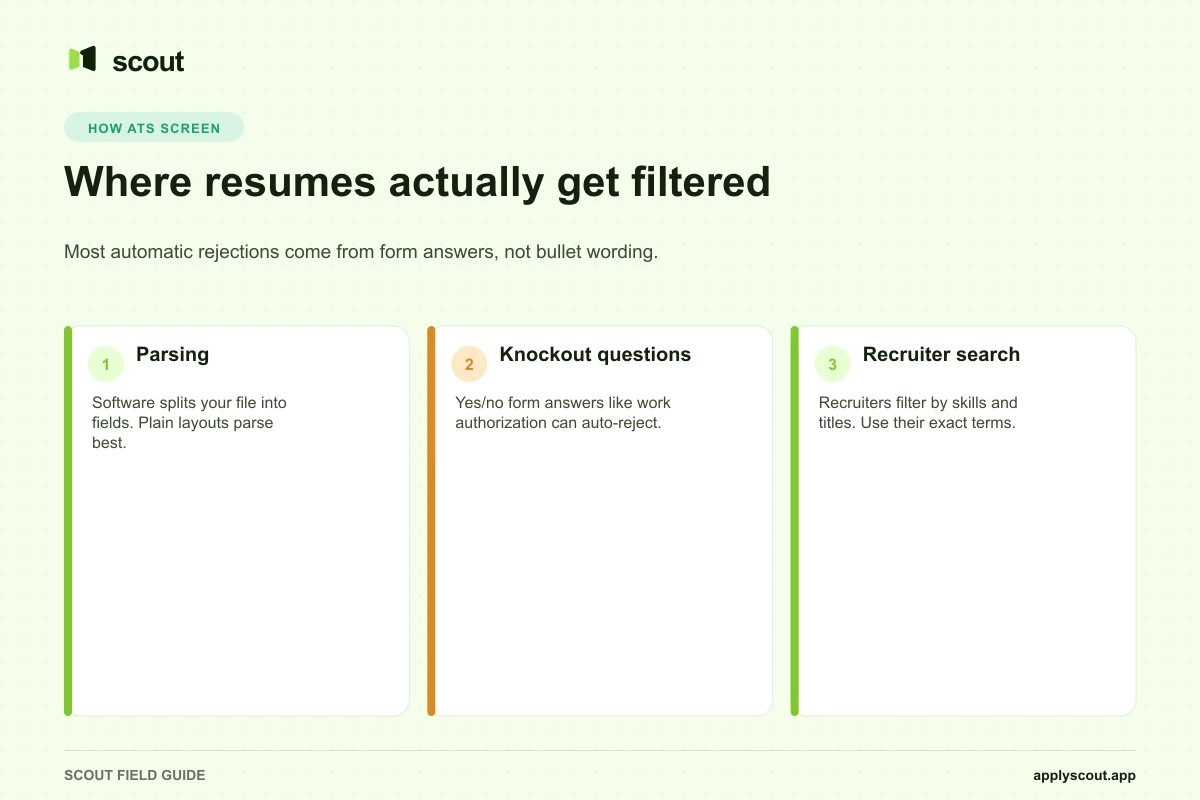
An applicant tracking system (ATS) is a database with a workflow on top. It does three jobs that matter to you.
1. It parses your resume. The system pulls text out of your file and tries to split it into fields: name, employers, titles, dates, education, skills. Odd layouts can confuse that step. A widely shared 2012 Computerworld piece described a Bersin & Associates test where a well-formatted resume scored only 43% relevance because the system misread it. Parsers have improved since, but a plain single-column layout is still the safest bet.
2. It runs knockout questions. These are the yes/no or multiple-choice questions on the application form. Greenhouse’s own help documentation on auto-reject explains that rules can only be attached to Yes/No, single-select, and multi-select questions, with the example of rejecting anyone who answers “no” to holding a Class A commercial driver’s license. In other words, the automatic rejections people fear usually come from the form answers, not from the wording of your bullets.
3. It lets recruiters search and filter. This is where tailoring pays off. In Jobscan’s 2025 State of the Job Search survey of 384 recruiters, 99.7% said they use filters in their ATS, 76.4% filter by skills, and 55.3% use job titles as a keyword. If a recruiter types “Salesforce” or “financial modeling” and your resume says “CRM” or “built forecasts,” you might be invisible even though you’re qualified.
Filters can also be blunt. Harvard Business School and Accenture’s Hidden Workers report (2021) found that 88% of employers agreed qualified high-skills candidates were screened out because they didn’t match the exact criteria in the job description, rising to 94% for middle-skills roles. That’s a real problem. The fix is precise, honest language, not invented qualifications.
The “75% of resumes are rejected by ATS” myth
You have probably read that 75% of resumes are rejected by software before a human sees them. Follow that number back and it runs out of road.
The earliest mainstream appearance we could find is that same March 2012 Computerworld article, which attributes the claim to Preptel, described as a “job search services provider.” No study, sample, or method is cited. Recruiter Jan Tegze traced the chain and reports that Preptel later went out of business, that the figure was part of its sales pitch, and that later repeats (including a 2014 Forbes contributor post by a resume-service founder) pointed back to the same unsupported source. We could not locate any Preptel dataset, so treat the 75% figure as unverified marketing.
What the more recent evidence says is narrower. Enhancv interviewed 25 US recruiters in September and October 2025 who use Workday, iCIMS, Greenhouse, Lever, and others. Twenty-three of them (92%) said their system does not auto-reject resumes for formatting or content, and all of them used knockout questions. It’s a small sample from a resume company, so weigh it accordingly, but it matches how the vendors document their own features.
So here is our honest read. Most rejections come from three places: you failed a knockout question, a recruiter searched and your resume didn’t surface, or a human read it among hundreds and moved on. Tailoring helps with the last two. Lying doesn’t help with any of them for long.
Honest tailoring vs. fabrication
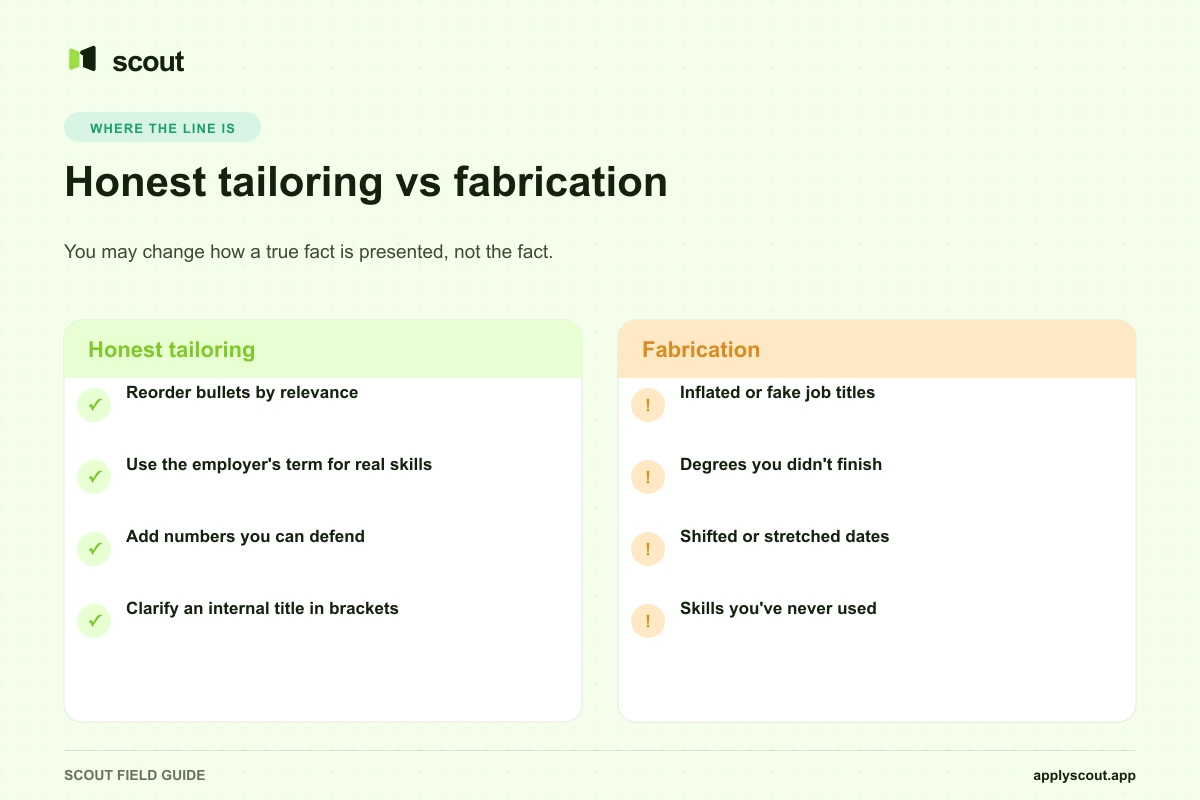
The line is simple to state. You may change how a true fact is presented. You may not change the fact.
| Honest tailoring (do it) | Fabrication (don’t) |
|---|---|
| Reorder bullets so the most relevant work comes first | Add a responsibility you never had |
| Use the employer’s term for a skill you actually used (“stakeholder management” instead of “worked with other teams”) | List a tool you’ve only watched a tutorial about |
| Add numbers you can defend (volume, time saved, revenue, error rate) | Inflate a number or invent one that “sounds right” |
| Promote a relevant side project, course project, or volunteer role into its own section | Present a side project as a paid job |
| Clarify an internal title: “Associate II (Data Analyst)“ | Replace your title with a more senior one |
| Cut irrelevant roles or compress older ones | Stretch or shift dates to hide a gap |
| Put the certification you hold near the top | Claim a degree or certification you didn’t finish |
The title row deserves a note. Internal titles can be meaningless outside the company. A parenthetical that describes the real function, kept next to the official title, helps the reader without misleading a background check. Swapping “Coordinator” for “Manager” does not.
Same with skills. If you used Tableau twice two years ago, you can list it, but you should be ready to talk about it in an interview. If you’ve never opened it, it doesn’t go on the page, no matter how many times the posting says it.
What resume lies actually cost
People do this a lot. In a ResumeBuilder survey of 1,250 US job applicants (July 2021), 32% admitted lying on their resume. The most common lies were years of experience (46%), education (44%), length of previous employment (43%), and skills (40%). Among those who lied and were found out, 41% said an offer was rescinded and 18% said they were fired after starting. It’s self-reported and a vendor survey, so read it as a direction rather than a precise rate.
Employers also catch discrepancies routinely. In HireRight’s 2025 Global Benchmark Report, more than three-quarters of respondents said they had uncovered candidate discrepancies in the past 12 months, and employment verification was the check North American respondents most often named (41%). HireRight is careful to add that some discrepancies are innocent, such as dates off by a month. That’s exactly why your dates and titles should match your records.
It can also be illegal. Texas, for example, makes it a Class B misdemeanor under Penal Code § 32.52 to use or claim a degree you weren’t granted with the intent to obtain employment. And the reputational damage can arrive years later. Yahoo CEO Scott Thompson resigned in May 2012 after a shareholder found that his official bio listed a computer science degree he hadn’t earned.
What a background check verifies
In the US, a third-party background check is governed by the Fair Credit Reporting Act. According to the FTC’s guide to employer background checks and your rights, an employer must get your written permission in a standalone document before using a background reporting company, and checks can cover employment history, education, criminal records, financial history, and public social media.
If the employer acts against you because of the report, the CFPB explains that they must share the report beforehand along with “A Summary of Your Rights under the Fair Credit Reporting Act,” and you can dispute inaccurate information. The FTC adds that you can ask the screening company for a free copy within 60 days of the employer’s decision.
Practical takeaway: a check compares what you wrote against what your former employers and schools report. Titles, dates, and degrees are the fields most likely to be verified, so they are the fields you never touch.
The 20-minute tailoring workflow
This assumes you already have a complete, truthful master resume with every role, project, and result you might ever use. If you don’t, build that first. Resume version control makes the rest of this far easier.
Minutes 0–4: Read the posting like a recruiter. Highlight the must-haves (often under “Requirements”) and the repeated nouns: tools, methods, domains, certifications. Note the exact job title.
Minutes 4–8: Build your keyword map. Use the table below. For every term, write the true evidence from your master resume, or write “gap.”
Minutes 8–14: Rewrite and reorder. Move the strongest matching bullets to the top of each role. Swap your wording for the employer’s wording only where the meaning is identical. Add numbers you can back up.
Minutes 14–17: Cut. Remove bullets that don’t support this job. One tight page or two for senior roles beats a complete history.
Minutes 17–20: Truth check and save. Reread every changed line and ask: could I explain this in an interview with a reference on the phone? Then save the file with the company and role in the name, so you know exactly which version you sent.
Keyword mapping template
Copy this into a doc or spreadsheet for each application.
| Employer’s term | Required or nice-to-have | My true evidence (role, project, result) | Where it appears on my resume | Honest? (Y / gap) |
|---|---|---|---|---|
| e.g. “SQL” | Required | Wrote weekly revenue queries at Company A | Company A, bullet 1; Skills | Y |
| e.g. “Looker” | Nice-to-have | None. Used Tableau | Not listed | Gap |
Gaps are fine. A gap tells you what to address in a cover letter or interview, or that this job is a stretch. It is never a prompt to invent.
A before-and-after bullet (hypothetical)
Here’s an illustrative example, not a real candidate. Say the posting is for a customer success manager and repeatedly mentions “churn reduction,” “onboarding,” and “Salesforce.”
Before:
Helped customers with account problems and worked with the sales team.
After (true version):
Ran onboarding for 40+ new mid-market accounts per quarter in Salesforce and cut 90-day churn from 9% to 6% by adding a week-two check-in call.
Everything in the “after” has to be true for this candidate: the account volume, the tool, the churn figures, and the check-in change. If they didn’t measure churn, the honest version drops the percentage and says what they did measure, or says nothing numeric at all.
What would cross the line: changing “Customer Success Associate” to “Customer Success Manager,” claiming they “owned a $2M book” when they supported a manager who did, or listing Gainsight because the posting mentions it.
Where Scout fits
Tailoring every application this way takes time, which is the main reason people stop doing it. If you want help, Scout’s Human Assistant gives you a dedicated person who finds matching roles, checks that postings are recent and from real companies, tailors your resume using only your real experience, and applies for you. They never invent jobs, skills, projects, or results.
You talk with your assistant in a private WhatsApp group, and your dashboard shows each job, the resume version used, and screenshots of important form answers, so you can audit what was sent. If you’re wondering how much control you keep, read whether a service can change your resume without permission. Plans start at $299 a month for Focused Search (250 applications a month), cancel anytime, with no placement fee or salary percentage. Scout doesn’t promise interviews. The lighter AI Assistant starts at $39 a month.
FAQ
Is it lying to copy keywords from the job description?
No, as long as the keyword describes something you actually did. Using the employer’s term for a real skill is translation. Adding a skill you don’t have because it appears in the posting is fabrication.
Can I change my job title on my resume?
Keep your official title. You can add a short clarifying descriptor in parentheses if your internal title doesn’t reflect the work, such as “Associate II (Data Analyst).” Don’t replace it with a more senior title, because employment verification can surface the mismatch.
Do ATS really reject 75% of resumes?
There’s no published study behind that number. It traces back to a 2012 claim by a resume-optimization vendor. Automatic rejections usually come from knockout questions on the application form, while most resumes are filtered by recruiter searches or human review.
How many versions of my resume should I keep?
One truthful master resume plus a saved copy of every tailored version you send. That way you can match what you say in an interview to exactly what the employer read.
What if I meet only some of the requirements?
Apply if you meet most of the must-haves and can show progress toward the rest. Address the gap honestly in your cover letter. Many postings list preferences, not hard rules, and the cover letter guide covers how to handle that.
Will a background check catch a fake skill?
Usually not directly, since checks focus on employment, education, and records. Interviews and technical tests catch fake skills instead, and that happens in front of the people you want to work with.
Ready to apply more without stretching the truth? See how Scout works or book a call to talk through your search.