Apps and Services That Apply to Jobs for You: 2026 Guide
By Scout Editorial Team · Published June 12, 2026 · Updated July 16, 2026
Yes, apps and managed services can apply to jobs for you—but they do not all provide the same level of help. Some only fill fields in a browser. Others find suitable jobs, prepare application materials, submit forms, and record what was sent. The best choice depends on how much control, human judgment, and evidence you want.
Before trusting any service with your professional identity, confirm four things: which jobs it can submit to, whether you approve them first, how it changes your resume, and what proof you receive after submission.
What “applies to jobs for you” can mean
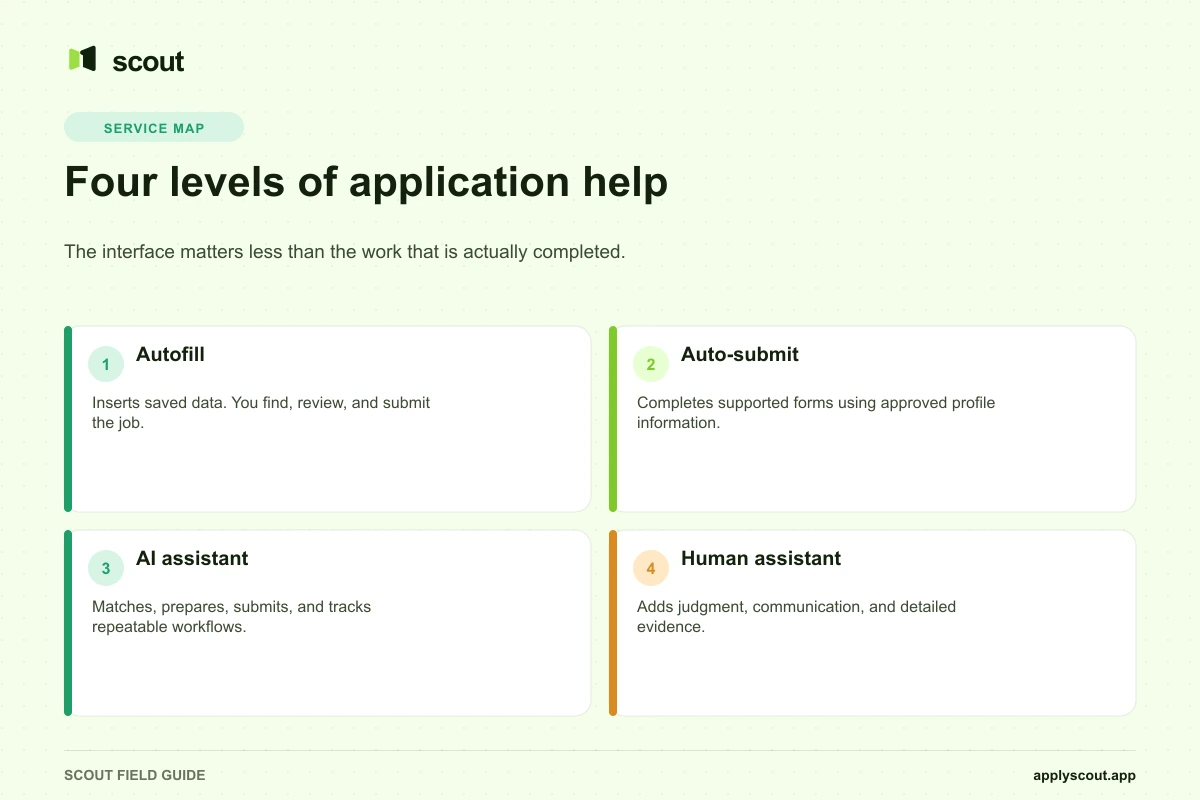
The phrase covers four different products:
| Service type | What it does | What you still do |
|---|---|---|
| Autofill extension | Inserts saved details into an open form | Find the job, review every field, and submit |
| Auto-submit tool | Completes supported applications | Set rules and review exceptions |
| Managed AI assistant | Finds or accepts jobs, prepares materials, submits, and tracks | Review your profile, rules, and results |
| Human application assistant | A person handles applications and communicates with you | Define the search and answer sensitive questions |
Do not assume “automatic” means the entire application is completed. Ask whether the service handles account creation, screening questions, document uploads, custom fields, and final submission on the sites you use.
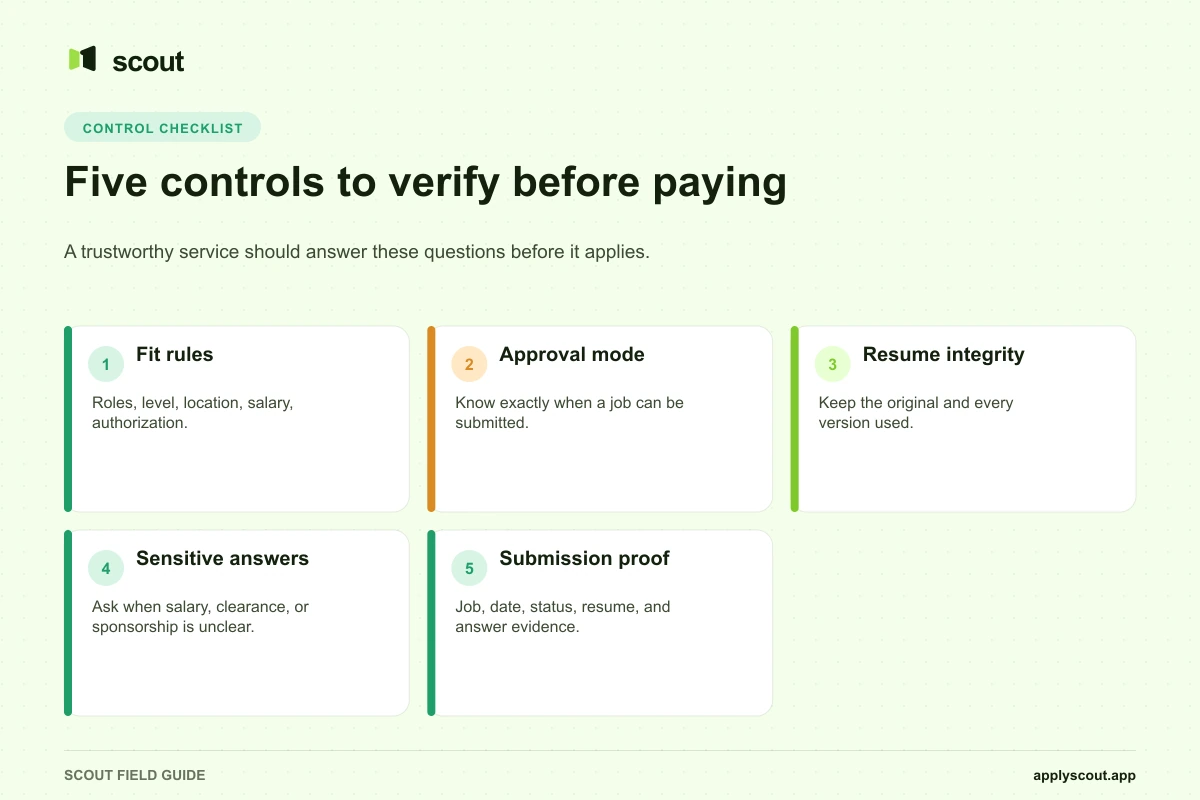
The five controls that matter most
1. Job-fit rules
A useful service should let you define target roles, seniority, locations, salary requirements, work authorization, contract preferences, and excluded employers. Keyword matching alone is not enough. “Product” could mean product manager, product designer, product marketing, or a physical production role.
2. Approval options
Different searches require different levels of control. A cautious user may want to approve every role. Someone with a narrow, trusted profile may allow applications that meet hard rules. A good service should explain which mode is active and what happens when a job is uncertain.
3. Resume integrity
Tailoring should emphasize relevant facts that already exist in your background. It should not invent skills, employers, dates, degrees, or results. Look for an untouched original resume, visible versions, and a record of which version went to each employer.
4. Sensitive-answer escalation
Salary, sponsorship, security clearance, disability, demographic, criminal-history, and legal questions should not be guessed. The service should use saved answers only when they are current and unambiguous, then ask you when a question falls outside those rules.
5. Submission evidence
At minimum, you should be able to see the company, role, source URL, date, status, and resume used. Stronger human services may also provide screenshots or records of important answers.
Browser extension, web service, or mobile app?
The interface matters less than the fulfillment model.
A browser extension can be useful for capturing a job you found and sending it to an application queue. A managed service can continue the work without requiring you to keep the same tab open. A mobile interface can make review convenient, but being mobile does not by itself make matching or submission more accurate.
Evaluate the work performed, the controls, and the evidence—not the device shown in the advertisement.
Human assistant or AI assistant?
Choose an AI Assistant when your search is relatively clear, your application answers are predictable, and you want a lower monthly cost. AI is well suited to extracting structured profile information, matching stated criteria, preparing drafts, and recording repeatable workflows.
Choose a Human Assistant when your search includes career changes, multiple role families, unusual work authorization, senior-level nuance, or application questions that need judgment. Human service also makes sense when you want a person you can contact and more detailed proof of completed work.
Scout offers both lanes on the same profile and application system:
- The AI Job Application Assistant uses guided resume import, job profiles, tailored materials, and application tracking.
- The Human Job Application Service adds a dedicated assistant, a private WhatsApp group, multiple profiles on eligible plans, and detailed application evidence.
Plan features and application allowances can change, so use the live pricing page rather than an old article or screenshot as the source of truth.
Can an application app guarantee interviews?
No responsible service can guarantee that an employer will interview or hire you. Outcomes depend on your experience, the labor market, compensation expectations, location, work authorization, competition, and interview performance.
A service can make enforceable promises about what it controls: application volume, turnaround time, matching rules, document handling, tracking, corrections, and refunds. Treat an interview or hiring guarantee carefully and read its eligibility rules.
Are job application apps safe?
They are not risk-free. Job boards set their own rules, and some prohibit third-party bots or automated activity. LinkedIn says it does not permit third-party software that automates activity on its website, while Indeed’s job-seeker guidelines tell users not to use third-party bots to apply.
Before using automation on any platform:
- Read the platform’s current terms.
- Understand whether the service uses your account or applies on employer career sites.
- Never approve false information.
- Keep volume and targeting reasonable.
- Monitor confirmation emails and your application history.
- Use a service that can pause immediately.
See the full job application bot safety guide for the platform-specific risks.
Questions to ask before paying
- Does the service submit applications or only fill fields?
- Can I approve every job?
- Can I maintain separate profiles for different role types?
- Does it preserve my original resume?
- Can I see the exact resume used for each job?
- How are salary, sponsorship, and demographic questions handled?
- How are duplicates prevented?
- Which sites are supported, and which are excluded because of platform rules?
- What happens when a form cannot be completed confidently?
- What evidence, correction policy, and refund terms do I receive?
Bottom line
An app that applies to jobs for you is valuable when it removes repetitive work without removing your control. The strongest services target appropriate roles, preserve truthful resume information, escalate sensitive questions, prevent duplicates, and show a reliable record of what was submitted.
Scout is designed around those operating controls rather than a “submit everywhere” promise. Compare the Human and AI workflows, then choose the amount of judgment and evidence your search needs.
Sources and methodology
This guide was updated against Scout’s current product and pricing pages on July 16, 2026. Platform-policy statements were checked against LinkedIn’s prohibited software guidance and Indeed’s Jobseeker Guidelines. Product availability and third-party rules can change.